In order to be able to get an idea of what people are thinking in regards to various Massachusetts laws relating to repeat offenders, operating under the influence of drugs or alcohol, vehicular homicide, and concurrent sentencing I will be putting a few polls up, located just under Diane's picture at left.
Polls will generally last for 30 days or longer.
All votes are anonymous and while you can only vote once, you can go back and change that vote.
Please take the time to vote.
Within the week I will be putting up a link to an online petition too. Be sure to check back as we start phase two of this site. Now that Parker has been sentenced and sent to jail (too briefly in my opinion) I will Begin to work in earnest to bring our motor vehicle laws in line with most other states. At this time Massachusetts is losing out on Federal funding because the driving laws are not in line with federal guidelines - Lets do something to fix that!
Showing posts with label DUI. Show all posts
Showing posts with label DUI. Show all posts
Saturday, July 28, 2007


Convicted driver pleads guilty to fifth DUI - Cape Cod Times
The following article is in today's issue of Cape Cod Times, as well as on their website. I promise that I will write up exactly what happened at both dispositions, I've just been unbelievably busy the last couple of days.
By Aaron Gouvea Cape Cod Times
July 28, 2007
FALMOUTH — Different court room, same result.
Christopher Parker, 50, pleaded guilty in Falmouth District Court yesterday to operating a motor vehicle under the influence of drugs and received a 2 ½-year sentence, six months above the minimum mandatory sentence for a fifth offense. In addition, he also received a one-year sentence for operating a motor vehicle negligently for the incident last October while driving in Bourne.
The sentences will run concurrently with the 2 ½-year sentence Parker received on Wednesday in Barnstable Superior Court, where he pled guilty to vehicular homicide.
Parker, of Forestdale, killed Diane Carhart, 63, in March when he slammed his Honda Accord into her Chevy Tracker on Route 130 in Sandwich. Police said Parker looked down to adjust a portable radio, causing the crash.
Although the last six months of his sentence will be suspended, he will be on probation for a combined four years. Parker will also have to submit to random drug and alcohol testing both in and out of prison, as well as alcohol counseling.
Carhart's daughter, Susan Linhares of Mattapoisett, is hopeful the punishments will serve as a fresh start for Parker and his family.
"I really do wish the man could clean himself up for his family's sake," Linhares said yesterday after Parker's court appearance. "My mother and I have never been vindictive people and while we won't forgive, we don't wish anybody harm."
By Aaron Gouvea Cape Cod Times
July 28, 2007
FALMOUTH — Different court room, same result.
Christopher Parker, 50, pleaded guilty in Falmouth District Court yesterday to operating a motor vehicle under the influence of drugs and received a 2 ½-year sentence, six months above the minimum mandatory sentence for a fifth offense. In addition, he also received a one-year sentence for operating a motor vehicle negligently for the incident last October while driving in Bourne.
The sentences will run concurrently with the 2 ½-year sentence Parker received on Wednesday in Barnstable Superior Court, where he pled guilty to vehicular homicide.
Parker, of Forestdale, killed Diane Carhart, 63, in March when he slammed his Honda Accord into her Chevy Tracker on Route 130 in Sandwich. Police said Parker looked down to adjust a portable radio, causing the crash.
Although the last six months of his sentence will be suspended, he will be on probation for a combined four years. Parker will also have to submit to random drug and alcohol testing both in and out of prison, as well as alcohol counseling.
Carhart's daughter, Susan Linhares of Mattapoisett, is hopeful the punishments will serve as a fresh start for Parker and his family.
"I really do wish the man could clean himself up for his family's sake," Linhares said yesterday after Parker's court appearance. "My mother and I have never been vindictive people and while we won't forgive, we don't wish anybody harm."
Friday, July 27, 2007
Disposition on October DUI charge against Parker
I'm leaving now to go to the Falmouth District Court in Falmouth, MA in order to see what Parker receives for a sentence. I've been told there is a chance that any jail time in this charge could be served concurrently to his jail time he is serving in Diane's case. I really hope that is not the case since this case happened 5 months before the crash that Parker has been found guilty of where Diane died, it was in a different location, with the cases in two different courthouses. I just don't see how they could do that.
I'll be back around 11am as far as I know and will post the results of the case when I get back home so stop back by in a few hours.
I'll be back around 11am as far as I know and will post the results of the case when I get back home so stop back by in a few hours.
Thursday, July 26, 2007
Parker pleads guilty to vehicular homicide - Cape Cod Times 7/26/07
This article appears in the Thursday edition of the Cape Cod Times. It has a bit more info and a different picture then the article I posted last evening.

The 63-year-old Forestdale grandmother was on Route 130 waiting to turn left into the Dunkin' Donuts parking lot at the Tradewinds Plaza in Sandwich when a Honda Accord slammed her Chevy Tracker from behind. Carhart's vehicle careened into the path of an on-coming NStar truck.
Carhart died shortly after.
Yesterday, Christopher G. Parker, 50, of Forestdale, the driver of the Honda, pleaded guilty to vehicular homicide and was sentenced to two and a half years in the Barnstable County Correctional Facility, the maximum allowed. Parker's inattention as he bent down to adjust a portable radio caused the crash, according to police.
The last six months of his sentence will be suspended, and he will be on probation following his release from jail. He will also serve a 10-day concurrent sentence for driving with a suspended license at the time of the accident.
"I don't think the sentence fit the crime, but he got what the state laws were," said Carhart's daughter, Susan Linhares of Mattapoisett following yesterday's proceeding in Barnstable District Court.
"I would like to see him serve all two and half years, but I'm glad that this is over and my family can move on," Linhares said.
Reading from victim impact statements composed by herself and her brother, John Everett of Williams, Ariz., she told the court that her mother had been her best friend — standing by her through many difficult times, including a recent battle with a brain tumor.
"I need my mother, I'm scared of life without her," she read.
Francine Abbott, who was driving the NStar truck and received an ankle injury in the crash, also read a statement.
"Because of you, my life and my family's life has been altered. Since that day, I've lived in pain and fear," she said. Abbott sobbed quietly as attorneys went over the details of the accident, and embraced Carhart's daughter after the sentence was read.
Parker apologized for the pain he caused Carhart's family. "If I could change anything it would be that day," said. Parker, who is already serving time on an unrelated matter. "I know my incarceration's going to be nothing compared to the loss of a human life."
Parker has a lengthy driving infraction record, which includes four drunken driving convictions, dating back to 1982. He also has a case pending in Falmouth District Court on a charge of operating a motor vehicle while under the influence of drugs in October in Bourne.
He is due back in court for this charge tomorrow.
Stephanie Vosk can be reached at svosk@capecodonline.com.

Christopher Parker stands in Barnstable District Court yesterday as he receives his sentence for motor vehicle homicide.
-Cape Cod Times /Paul Blackmore
BARNSTABLE — The morning of March 5 was a typical one for Diane Carhart.
After hanging up the phone with her daughter, she was off to get her vanilla-frosted doughnut with sprinkles and an iced coffee.
After hanging up the phone with her daughter, she was off to get her vanilla-frosted doughnut with sprinkles and an iced coffee.
The 63-year-old Forestdale grandmother was on Route 130 waiting to turn left into the Dunkin' Donuts parking lot at the Tradewinds Plaza in Sandwich when a Honda Accord slammed her Chevy Tracker from behind. Carhart's vehicle careened into the path of an on-coming NStar truck.
Carhart died shortly after.
Yesterday, Christopher G. Parker, 50, of Forestdale, the driver of the Honda, pleaded guilty to vehicular homicide and was sentenced to two and a half years in the Barnstable County Correctional Facility, the maximum allowed. Parker's inattention as he bent down to adjust a portable radio caused the crash, according to police.
The last six months of his sentence will be suspended, and he will be on probation following his release from jail. He will also serve a 10-day concurrent sentence for driving with a suspended license at the time of the accident.
"I don't think the sentence fit the crime, but he got what the state laws were," said Carhart's daughter, Susan Linhares of Mattapoisett following yesterday's proceeding in Barnstable District Court.
"I would like to see him serve all two and half years, but I'm glad that this is over and my family can move on," Linhares said.
Reading from victim impact statements composed by herself and her brother, John Everett of Williams, Ariz., she told the court that her mother had been her best friend — standing by her through many difficult times, including a recent battle with a brain tumor.
"I need my mother, I'm scared of life without her," she read.
Francine Abbott, who was driving the NStar truck and received an ankle injury in the crash, also read a statement.
"Because of you, my life and my family's life has been altered. Since that day, I've lived in pain and fear," she said. Abbott sobbed quietly as attorneys went over the details of the accident, and embraced Carhart's daughter after the sentence was read.
Parker apologized for the pain he caused Carhart's family. "If I could change anything it would be that day," said. Parker, who is already serving time on an unrelated matter. "I know my incarceration's going to be nothing compared to the loss of a human life."
Parker has a lengthy driving infraction record, which includes four drunken driving convictions, dating back to 1982. He also has a case pending in Falmouth District Court on a charge of operating a motor vehicle while under the influence of drugs in October in Bourne.
He is due back in court for this charge tomorrow.
Stephanie Vosk can be reached at svosk@capecodonline.com.
Wednesday, July 25, 2007
Is Today the Day???
I feel almost like a little kid waiting for Santa on Christmas Eve or trying to sleep the day before a birthday, the anticipation that I have had for today to come has been great.
Could today be the day that Parker accepts guilt for killing my Mom, Diane? Will I finally be able to read the impact statements that my brother and I have written? Will Francine Abbott be there with a victim impact statement? How will Parker act while we are reading the statements? Will he show any remorse at all or just stare ahead blankly like he has done in his other court appearences? Will the Judge sentence him to the full sentence? Basically, what will happen?
I've had my clothes picked out and ironed for days, wanting to look respectable in front of the Judge. I have been surprized at what some of the people who appear before the Judges (either defendant or plaintiff) wear, anything from dirty jeans and stained, ripped tee-shirts to short mini skirts with half tank tops.
Well I guess I'll go shower and get ready. I want to leave an extra hour early incase of Cape Cod traffic or road work.
Could today be the day that Parker accepts guilt for killing my Mom, Diane? Will I finally be able to read the impact statements that my brother and I have written? Will Francine Abbott be there with a victim impact statement? How will Parker act while we are reading the statements? Will he show any remorse at all or just stare ahead blankly like he has done in his other court appearences? Will the Judge sentence him to the full sentence? Basically, what will happen?
I've had my clothes picked out and ironed for days, wanting to look respectable in front of the Judge. I have been surprized at what some of the people who appear before the Judges (either defendant or plaintiff) wear, anything from dirty jeans and stained, ripped tee-shirts to short mini skirts with half tank tops.
Well I guess I'll go shower and get ready. I want to leave an extra hour early incase of Cape Cod traffic or road work.
Wednesday, July 18, 2007
Parker's October DUI Charges Postponed Again
On Wednesday, July 18 at 9:00am I was once again at the Falmouth District Courthouse in Falmouth, MA in order to hear what would transpire with the DUI charges that Christopher G. Parker is facing when he was arrested last October in Bourne.
A different Judge was now presiding on the case due to the health of the original Judge. Judge Nagler is now assigned to the case. When "Commonwealth vs. Christopher G. Parker" was called A.D.A. Ilene Connors as well as Parker's Attorney Arnold Lett requested a side bar with the judge. The three of them spoke for several minutes and then a Disposition date of July 27, 2007 at 9:00am was announced. It is hoped that Parker will either plead or be found guilty of the DUI charge on that date.
A different Judge was now presiding on the case due to the health of the original Judge. Judge Nagler is now assigned to the case. When "Commonwealth vs. Christopher G. Parker" was called A.D.A. Ilene Connors as well as Parker's Attorney Arnold Lett requested a side bar with the judge. The three of them spoke for several minutes and then a Disposition date of July 27, 2007 at 9:00am was announced. It is hoped that Parker will either plead or be found guilty of the DUI charge on that date.
Wednesday, May 2, 2007
Are felony DWI offenders getting away with murder?
The article below is from Houston, TX, KHOU channel 11's website. The story sounds all to familiar, and is actually what my family and I have been saying from the moment that we learned about Christopher Parker's extensive DWI/OUI arrest record. I've also mentioned that it seemed as if Parker knew how to work the system. It seems that each and every day repeat offenders are picked up for driving while intoxicated. Unfortunately those offenders do not go to jail each and everyday, but are allowed out on bail or probation...with promises of doing a couple of hours of community service. While this story below is based in Texas I thought it was very appropriate for our site.
Are felony DWI offenders getting away with murder?
11:57 AM CDT on Sunday, April 29, 2007
By Dave Fehling / 11 News
In the past two years, police in Harris County charged over 1,900 drivers with felony DWI, but some say chronic offenders have learned to work the system and never pay the price.
For example, an allegedly very drunk driver was accused last month of killing a mother and daughter in a horrific smash-up on the Eastex Freeway.
Police said he’d already had three previous DWI convictions.
“They’re not following through on penalties,” said Ruth Tijerina, who lost her daughter in a drunk driving crash in 2004.
Texas has the three strikes DWI law: The third arrest means a felony charge. Felony as in prison, loss of voting rights and public humiliation.
But when 11 News asked the county to provide us with records showing what really happens, what we discovered was disturbing.
In the past two years in Harris County alone, 492 of the more than 1,900 felony DWI cases were reduced to misdeameanor charges.
“At some point, they need to be locked away,” said John Bradley, the Williamson County D.A. known for its tough stance on DWI.
So why aren’t they?
“Your chronic DWI offender, the person who has two or more prior arrests for DWI, has completely learned how to work the system,” said Bradley.
Are felony DWI offenders getting away with murder?
11:57 AM CDT on Sunday, April 29, 2007
By Dave Fehling / 11 News
In the past two years, police in Harris County charged over 1,900 drivers with felony DWI, but some say chronic offenders have learned to work the system and never pay the price.
For example, an allegedly very drunk driver was accused last month of killing a mother and daughter in a horrific smash-up on the Eastex Freeway.
Police said he’d already had three previous DWI convictions.
“They’re not following through on penalties,” said Ruth Tijerina, who lost her daughter in a drunk driving crash in 2004.
Texas has the three strikes DWI law: The third arrest means a felony charge. Felony as in prison, loss of voting rights and public humiliation.
But when 11 News asked the county to provide us with records showing what really happens, what we discovered was disturbing.
In the past two years in Harris County alone, 492 of the more than 1,900 felony DWI cases were reduced to misdeameanor charges.
“At some point, they need to be locked away,” said John Bradley, the Williamson County D.A. known for its tough stance on DWI.
So why aren’t they?
“Your chronic DWI offender, the person who has two or more prior arrests for DWI, has completely learned how to work the system,” said Bradley.
Monday, April 30, 2007
Barnstable County House of Correction
Several of us were wondering what exactly happens when someone is taken to the Barnstable County House of Correction. A quick search of the internet found the following information and photos from the Barnstable County Sheriff's office website.....


The Barnstable County House of Corrections Facility (BCCF) is located at the Massachusetts Military Reservation in the Town of Bourne. A formal ground-breaking ceremony was held in September 2002 for the new BCCF, a forty million dollar facility located on the Massachusetts Military Reservation in Bourne. The new three hundred cell BCCF is a state of the art, direct supervision facility.
Booking Procedures
Booking Procedures
The Barnstable County Sheriff’s Office services a daily inmate population of approximately 300 individuals. All of these individuals must go through the booking intake process. Each individual received is processed in the same manner:
- Searched
- All property taken-logged and bagged
- Processed through the identification-fingerprints, photos, etc.
- Medically screened for obvious injuries-medical treatment given if needed at time of booking
- Booked in and advised of their charges and means of release if any.
If unable to secure release they are placed in appropriate facility attire and given the following items:
- Starter Hygiene Kit
- 2 Sheets
- Blanket
- Pillow
- Pillow Case
- 2 Jumpsuits
- Towel
- Sneakers (1 pair)
After the initial booking process is completed, the individuals are then classified into one of several classifications. The initial classifications are as follows:
- High Risk
- Medium Risk
- Low Risk
From the above, individuals are placed into the appropriate section.
Telephone Calls
Every section within the facility has access to their own telephone. Phones are not turned on before 9:00 a.m. for security reasons. Shut off time may vary depending on the section individuals are housed in and could be as late as 10:00 p.m. All calls are collect calls only. An individual is only allowed to call seven (7) different phone numbers. The initial numbers entered determine whom that individual can call for the remainder of their stay.
If you do not wish to accept phone calls from an individual at the Barnstable County Correctional Facility, the phone system will prompt you through the process to eliminate any further unwanted calls.
Inmates in our Discipline Unit are only allowed one fifteen-minute phone call per ten days. The phone system will not allow call forwarding or three-way calling.
Inmate Mail
Inmates may write and receive unlimited correspondence. Postage paid envelopes and writing paper are available for inmates to purchase through the Canteen.
Inmates are authorized to receive books (paperback only, no hard covers) and magazines that meet our criteria, only if they are purchased and sent from a publisher. Examples that do not meet our criteria are:
- Any sexually explicit material; or any material that may cause sexual arousal or encourage sexual behavior.
- Any material that contains instructions for manufacturing explosives, drugs, weapons or other unlawful materials.
- Any material that advocates violence or disruption within a facility.
- Any material that advocates any racial, religious or national hatred in such a way to create violence in the facility.
Books and magazines or other types of periodicals that are received from any source other than directly from a publisher will be returned to sender.No correspondence will be accepted from any other correctional facility or secure treatment facility.All outgoing mail is stamped as coming from our institution.Outgoing and Incoming mail will be inspected for contraband or security breaches with the exception of legal mail. When necessary, legal mail will be opened in the presence of staff.
Acceptance of Inmate Funds
Inmates are not allowed to have any monies in their possession. Under NO circumstances will an inmate while in court accept any monies from family, friends or attorney.During the booking process, all monies will be deposited in the inmate’s canteen account.Inmate receipt of funds can only take place during regular business hours or through the U.S. Postal Service. The following are the only accepted forms of currency:Postal Money Order, Bank Check, or Cash at the BCCF, no cash through the mail.
Clothing Exchange/Court Clothing
Inmates will be allowed to exchange their clothing received at the time of booking for court clothes only. The exchange process takes place Monday through Friday 8:00 a.m. to 12:00 p.m. only. All exchanges are made item for item.Court clothing should be clean and pressed. Jeans, sneakers, shorts, sweat suits, or flip-flops are not considered acceptable court clothing.
General Rules and Regulations Regarding Visits
A complete listing of rules and regulations can be found posted in the visiting waiting area in the Lobby area of the BCCF. All inmates are required to fill out a Visitor Pre-Approval form during the intake process. This form allows for all inmates to have a maximum of five (5) visitors pre-approved through our Special Operations department to visit within the facility. Any visitor not listed on this form at the time of a visit will not be allowed to visit. If you are visiting the facility for the first time you are required to fill out a Request to Visit Inmate card which can be obtained in the Visiting Lobby of the BCCF.

All visitors shall produce a current photographic I.D. (i.e. State Driver’s License). Exceptions may be made by the Sheriff, Special Sheriff, Superintendent Deputy Superintendent, Assistant Deputy Superintendents or the Director of Security.
Two (2) adults, with one (1) child or one (1) adult with two children may visit an inmate at the same time, provided they register together with the Visit Reception Officer. Persons under eighteen (18) years of age will not be allowed to visit unless they are accompanied by a parent or legal guardian and meet the following provisions:
- Proof of the minor’s relationship to the inmate. A birth certificate or adoption papers must be presented at each visit.
- In the absence of a parent or legal guardian, a visit for a minor child or sibling may be granted. Minors are allowed to visit their parent, step-parent, grandparent, legal guardian, or sibling. Prior to a visit being granted, an approved permission to visit form, available in the Visits Lobby area, from the parent or legal guardian must be submitted to the Superintendent or his/her designee. The form must specify the child’s name, the person authorized to bring the minor into the facility, the inmate’s name and the signature of the parent or legal guardian submitting the form. The form must be notarized by a Notary Public commissioned by the state of Massachusetts . This notarized letter must be presented by the visitor at each time of visit.
All inmates, male and female, shall be allowed 2 visiting periods, (one hour per visit) plus Thanksgiving and Christmas. A maximum of four visitors may visit per day per inmate, no more than two visits at any one time, in the one hour span.
Visitor Guidelines for the Visiting Room
- Disruptive Behavior – Loud or abusive language will not be tolerated
- Physical Contact – No physical contact is allowed
- Fighting or Disruptive Conduct – Actions which disrupt the visiting room will not be tolerated and will result in the termination of the visit.
- Contraband – Nothing shall be passed or given to the inmate by the visitor without permission of the Lobby Officer or his/her designee.
- Under the influence – Visitors who appear under the influence of alcohol or drugs will not be allowed to visit.
- Children– Visitors shall be responsible for their children at all times.
- Dress Code – Any persons wearing inappropriate clothing and/or outfits will not be allowed to visit. The following clothing items are not allowed:
No halter tops
No sleeveless shirts
No spandex
No bare midriff
No suggestive clothing
No bare feet
Visitors must wear undergarments
Friday, March 30, 2007
Another Vehicular Homicide Case in Barnstable County
The following article appears in today's Cape Cod Times. While it has nothing at all to do with my Mother's death, allegedly caused by Christopher G. Parker, it does go to show how lenient the sentences for vehicular homicide while under the influence are in Barnstable County. This man in the article below could have received up to 15 years in State prison, but instead was sentenced to 2½ years in the Barnstable County Correctional Facility, with 18 months to serve. I find this sentence an insult against the person who lost their life and the surviving family members!
How is it that human life is no more valuable then putting the guilty party behind bars for only 18 months? How is it that you can murder someone with an automobile and yet not get a sentence that is in line with other non-automobile related murders? As I see it after only 18 months the victim is still dead and yet the guilty party receives not too much more then a scolding by way of a brief 18 month sentence. What does this type of enforcement say about this State to our children or others who are new to Massachusetts?
It is my wish thatthe Massachusetts District Courts, as well as the District Attorney's offices do their job to the best of their ability, which includes following ALL leads even if they are given by the victim's family or the State Police, return calls by the victim's family promptly and additionally charge the defendant with all the charges that apply and are due, especially if there is death resulting. I'm sure other families who have lost loved ones to vehicular homicide or homicide by motor vehicle share my feelings that the guilty party seems to be much more important in our criminal court system then the person who has lost their life due to the selfishly negligent actions of the guilty man or woman. Innocent until proven guilty is a great concept, one that I wholeheartedly support. However once the defendant is found guilty the court system should sentence them to the full extent of the law. How else will the laws of the Commonwealth of Massachusetts be taken seriously and not be what is considered a joke that enables habitual offenders?
By Hilary Russ Staff Writer Barnstable - Victims of a 2005 drunken driving accident in Bourne described in agonizing detail yesterday the horrible moments that still haunt their family when their unborn baby Holly was lost after the crash.
''This tragedy defines who I am today. I know it shouldn't, but it does,” the unborn baby's mother said in court. ''My hope is that people will learn from this, be scared by it and make different choices.”
Adrien Aube, 69, of Plymouth pleaded guilty yesterday in Barnstable Superior Court to motor vehicle homicide while operating under the influence of alcohol and negligent operation, a charge that carries a sentence of up to 15 years in state prison. He also pleaded guilty to operating under the influence of alcohol, causing serious injury.
On July 17, 2005, a five-vehicle crash on Route 25 in Bourne seriously injured a pregnant woman, whose unborn baby was subsequently lost.
Adrien Aube of Plymouth, whose drunken driving caused the crash, has pleaded guilty to motor vehicle homicide in the case.
After playing golf the day of the crash, Aube downed several mixed vodka drinks before heading onto Route 25, Assistant District Attorney Holly Harney said in court. His speeding black Ford Thunderbird careened across the median into oncoming traffic a mile west of the Bourne Bridge. He slammed head-on into the Toyota Camry driven by the pregnant woman and hit several other cars.
Harney said the unborn baby was ''viable” and was pronounced dead as a result of injuries sustained in the crash.
After reaching a plea deal, Aube was sentenced to 2½ years in the Barnstable County Correctional Facility, with 18 months to serve.
After release, he will be on probation for three years. His license is revoked for the rest of his life, and on his release from jail he must view a photo of the unborn baby and read the victim impact statements submitted to the court.
Aube, with white hair, a white moustache and glasses, bowed his head as he listened to statements read by the unborn baby's mother and father.
Blow by blow, the parents laid out a catalogue of agonies. They recounted the woman fading in and out of consciousness as firefighters unpinned her from under the dashboard. They spoke of several large blood clots in the woman's lungs and the removal of her spleen.
''You've introduced fear into our lives,” the unborn baby's father said. His wife said she remembers Holly's purple lips as the baby lay dead under a sheet. She said she has nightmares of babies turning into stone.
Hilary Russ can be reached at hruss@capecodonline.com.
(Published: March 30, 2007)
How is it that human life is no more valuable then putting the guilty party behind bars for only 18 months? How is it that you can murder someone with an automobile and yet not get a sentence that is in line with other non-automobile related murders? As I see it after only 18 months the victim is still dead and yet the guilty party receives not too much more then a scolding by way of a brief 18 month sentence. What does this type of enforcement say about this State to our children or others who are new to Massachusetts?
It is my wish thatthe Massachusetts District Courts, as well as the District Attorney's offices do their job to the best of their ability, which includes following ALL leads even if they are given by the victim's family or the State Police, return calls by the victim's family promptly and additionally charge the defendant with all the charges that apply and are due, especially if there is death resulting. I'm sure other families who have lost loved ones to vehicular homicide or homicide by motor vehicle share my feelings that the guilty party seems to be much more important in our criminal court system then the person who has lost their life due to the selfishly negligent actions of the guilty man or woman. Innocent until proven guilty is a great concept, one that I wholeheartedly support. However once the defendant is found guilty the court system should sentence them to the full extent of the law. How else will the laws of the Commonwealth of Massachusetts be taken seriously and not be what is considered a joke that enables habitual offenders?
Man pleads guilty to vehicular homicide
By Hilary Russ Staff Writer Barnstable - Victims of a 2005 drunken driving accident in Bourne described in agonizing detail yesterday the horrible moments that still haunt their family when their unborn baby Holly was lost after the crash.
''This tragedy defines who I am today. I know it shouldn't, but it does,” the unborn baby's mother said in court. ''My hope is that people will learn from this, be scared by it and make different choices.”
Adrien Aube, 69, of Plymouth pleaded guilty yesterday in Barnstable Superior Court to motor vehicle homicide while operating under the influence of alcohol and negligent operation, a charge that carries a sentence of up to 15 years in state prison. He also pleaded guilty to operating under the influence of alcohol, causing serious injury.
On July 17, 2005, a five-vehicle crash on Route 25 in Bourne seriously injured a pregnant woman, whose unborn baby was subsequently lost.
Adrien Aube of Plymouth, whose drunken driving caused the crash, has pleaded guilty to motor vehicle homicide in the case.
After playing golf the day of the crash, Aube downed several mixed vodka drinks before heading onto Route 25, Assistant District Attorney Holly Harney said in court. His speeding black Ford Thunderbird careened across the median into oncoming traffic a mile west of the Bourne Bridge. He slammed head-on into the Toyota Camry driven by the pregnant woman and hit several other cars.
Harney said the unborn baby was ''viable” and was pronounced dead as a result of injuries sustained in the crash.
After reaching a plea deal, Aube was sentenced to 2½ years in the Barnstable County Correctional Facility, with 18 months to serve.
After release, he will be on probation for three years. His license is revoked for the rest of his life, and on his release from jail he must view a photo of the unborn baby and read the victim impact statements submitted to the court.
Aube, with white hair, a white moustache and glasses, bowed his head as he listened to statements read by the unborn baby's mother and father.
Blow by blow, the parents laid out a catalogue of agonies. They recounted the woman fading in and out of consciousness as firefighters unpinned her from under the dashboard. They spoke of several large blood clots in the woman's lungs and the removal of her spleen.
''You've introduced fear into our lives,” the unborn baby's father said. His wife said she remembers Holly's purple lips as the baby lay dead under a sheet. She said she has nightmares of babies turning into stone.
Hilary Russ can be reached at hruss@capecodonline.com.
(Published: March 30, 2007)
Wednesday, March 28, 2007
Change of Falmouth District Court Date
Christopher G. Parker's court date of March 30, 2007 in Falmouth District Court, where he was to appear on charges of driving under the influence of drugs this past October, has been continued until April 27, 2007 at 9:00am at the request of his Attorney.
Saturday, March 24, 2007
Man accused in fatal crash to get hearing
Man accused in fatal crash to get hearing
CAPE COD TIMES SANDWICH - Christopher G. Parker, the man accused of causing a three-car crash March 5 that killed a Forestdale grandmother, will plead his case before a clerk magistrate.
Parker, 50, faces a clerk magistrate hearing April 4 at 2 p.m. to determine probable cause to charge him with vehicular homicide and other charges related to the crash, police said. The hearing will be held in Barnstable District Court.
Parker requested the clerk magistrate hearing, which is closed to the public. The magistrate will decide to advance the charges to district court or dismiss the charges.
Parker was issued a citation in the Route 130 crash for vehicular homicide and driving after his license was revoked. He has an extensive driving infraction record, including four convictions for driving under the influence of alcohol.
On Friday, Parker is due in Falmouth District Court for a pretrial hearing on a charge of operating under the influence of drugs in an unrelated driving incident. In October, state police arrested Parker in Bourne and charged him with operating under the influence of drugs.
(Published: March 24, 2007)
Friday, March 23, 2007
Statistics from M.A.D.D.
- Alcohol is closely linked with violence. About 40 percent of all crimes (violent and non-violent) are committed under the influence of alcohol. (Bureau of Justice Statistics, 1998)
- About three in every ten Americans will be involved in an alcohol-related crash at some time in their lives. (NHTSA, 2001)
- above from http://www.madd.org/stats/1789
- Fatally injured drivers with BAC levels of 0.08 g/dl or greater were 9 times as likely to have a prior conviction for driving while intoxicated compared to fatally injured sober drivers. (NHTSA, 2004).
- The risk of a driver who has one or more DWI convictions becoming involved in a fatal crash is about 1.4 times the risk of a driver with no DWI conviction. (NHTSA, 2000)
- About one-third of all drivers arrested or convicted of driving while intoxicated or driving under the influence of alcohol are repeat offenders. (Fell, 1995)
- above from http://www.madd.org/stats/4542
Higher-Risk Drivers: The Problem
Higher-Risk Driver: MADD defines the “higher-risk driver” as 1) Repeat offenders convicted (conviction is defined as receiving a court-imposed sanction) of a second driving-under-the-influence offense within a 5- year period; 2) High BAC offenders convicted of a driving-under-the-influence offense with a BAC of .15% or higher; and/or 3) Driving-while-suspended (DWS) where the suspension was the result of a conviction for driving under the influence.
THE PROBLEM
Repeat Offenders:
- About one-third of all drivers arrested or convicted of driving under the influence are repeat offenders. These drivers are 40% more likely to be involved in a fatal crash than those without prior DUIs.
High-BAC Offenders:
- Over half of alcohol-related traffic fatalities involve drivers with a BAC of .15% and above.2 These drivers are at least 382 times more likely to be involved in a fatal crash than a non-drinking driver.
- During a typical weekend night, 1% of drivers will have a blood alcohol concentration (BAC) of .15 or higher.
Offenders Who Drive on a Suspending License:
- 50-75% of drunk drivers whose licenses are suspended continue to drive.
- 32% of suspended second-time offenders and 61% of suspended third-time offenders received violations or were involved in crashes during their suspensions.
- Generally, unlicensed drivers are 4.9 times more likely to be involved in a fatal crash than properly licensed drivers.
- above from http://www.madd.org/stats/11001
- Impaired driving is the most frequently committed violent crime in the United States.
- About one-third of all drivers arrested or convicted of driving while intoxicated or driving under the influence of alcohol (DWI) have a previous DWI conviction.
- Drivers with prior DWI convictions are over-represented in fatal crashes and have a greater relative risk of
- Between 50 and 75 percent of those whose licenses are suspended due to a DUI continue to drive illegally. Over 60 percent of 3rd time DUI offenders, who have their license suspended, commit some manner of traffic violation during their suspension/revocation period.
- above from http://www.madd.org/news/9856
Thursday, March 22, 2007
Forestdale man charged with vehicular homicide
UPDATE: The Magistrate's Hearing on the charges of vehicular homicide due to negligence as well as driving on a revoked license that Christopher G. Parker has requested will be held on Wednesday April 4, 2007 at 2:00pm at the Barnstable District Court House on Cape Cod. Directions are located here. Please contact me if you plan to attend.
Forestdale man charged with vehicular homicide
By GEORGE BRENNAN STAFF WRITER SANDWICH - Christopher G. Parker was issued a citation this week charging him with vehicular homicide in the March 5 death of Diane Carhart, the police said.
Parker, 50, of Forestdale, was also cited for driving with a revoked license.
The citation makes official what police have said since shortly after the three-car crash on Route 130: They believe Parker was responsible for causing the fatal wreck.
There are indications Parker requested a hearing before a clerk-magistrate, as is his right, but no date has been set, according to a Barnstable District Court clerk.
Parker has a lengthy driving infraction record, which includes four drunken driving convictions, dating back to 1982. He also has a case pending in Falmouth District Court on a charge of operating a motor vehicle while under the influence of drugs in October in Bourne.
Not only had his license been revoked at the time of the Sandwich crash because state police considered him an ''immediate danger,” but his license had also been suspended for failure to pay a speeding ticket, Massachusetts Registry of Motor Vehicle records indicate.
Police have not cited Parker for operating under the influence in connection with Carhart's death but have said the investigation of the crash continues and more charges could follow.
Had Parker waived his right to a magistrate's hearing, a date would have been set for an arraignment in Barnstable District Court.
In a magistrate's hearing, the clerk will decide whether police have shown probable cause for the charge to be pursued in district court. If probable cause is established, an arraignment will be scheduled, but the magistrate also has the authority to dismiss the criminal complaint.
Magistrate hearings are typically closed to the public.
During a court appearance last week on the Bourne charge, Parker was issued a warning by a judge that if he was charged with any other crime his $1,000 bail could be revoked and he could be jailed for up to 60 days.
He had not been officially charged in the fatal three-car crash at the time of his hearing last week.
George Brennan can be reached at gbrennan@capecodonline.com.
(Published: March 22, 2007)
Driving to Endanger - Patriot Ledger Series
I found a series of articles regarding DWI, Melanie's Law and the laws in Massachusetts that was run in the Patriot Ledger over the last few years. I have put a link in the links section at left to a page of this series that covers how Mass. is lagging behind other states in their DWI laws and convictions. As you read through these quotes and graphics I hope you will follow the links to read through this whole series. Only by making others aware of the lax laws in Massachusetts can we make a change. How can a state that is as pro-active as Massachusetts have such archaic laws as they apply to drunk or drugged driving and repeat offenders who obviously have no respect for the law and will not be rehabilitated. We allow Gay marriage (the only state to do so) and fight for the rights of illegal immigrants (they are here illegally), but will not keep people who abuse the law repeatedly off the streets - something just isn't right here!
Here are a few quotes from this series:
* Massachusetts is the worst in the nation at finding out who’s been drinking, driving and causing deadly crashes. - http://www.southofboston.net/specialreports/drunkendriving/111806a.shtml
* Surviving drivers were tested in only five of 296 fatal crashes in Massachusetts last year. That's 1.7 percent, lowest in the country. According to the National Highway Traffic Safety Administration, the national average was 31 percent.
The federal agency has pushed for years to test all drivers involved in deadly accidents. But nine states, including Massachusetts, still do not require or even recommend blood-alcohol testing of surviving drivers in fatal crashes.
Massachusetts tests nine out of 10 victims of fatal crashes as part of routine autopsies. -
http://www.southofboston.net/specialreports/drunkendriving/111806a.shtml
* Flunking the test: Mass. policy is nation's most lax
Massachusetts has no law requiring alcohol testing, but five other states do.Drivers involved in fatal accidents in New Hampshire have no right to refuse blood-alcohol tests if they’re suspected of causing the crash.
“The officer can actually, if need be, restrain the person physically while the blood is being withdrawn,” said Earl Sweeney, assistant commissioner of public safety in New Hampshire.
Maine has the same policy, but it applies to all fatal accidents regardless of who’s at fault.
“We test anybody in a serious accident where death occurs or is likely to occur,” said Kennebec County District Attorney Evert Fowle, head of the Maine Prosecutors Association. “It’s certainly called for by the law, and we do it.”
Maine tests 77 percent of drivers involved in fatal crashes, second only to South Carolina’s 94 percent. New Hampshire tested 32 percent, slightly above the national average.
But in Massachusetts, police can ask drivers to take a test only after they’ve been arrested for drunk driving. Here, the number tested is less than 2 percent. No other state tests so few drivers.
- http://www.southofboston.net/specialreports/drunkendriving/111806a.shtml
* Good lawyers, soft judges: Drunks still drive - No jail time for 85% of those convicted
...and more than two dozen other South Shore drivers who are currently facing their third, fourth, fifth, even eighth drunken driving offenses.
Why are they still on the road?
Prosecutors, police and anti-drunken driving advocates say the answer lies in a 10,000-word state law that treats drunken driving as a petty crime, gives judges wide latitude in sentencing and allows even chronic drunken drivers to claim hardship to get their licenses back. An overloaded court system, cutbacks in alcohol treatment and a Legislature reluctant to adopt tougher sentencing mandates also contribute to the problem, they say.
All of this has combined to give Massachusetts one of the nation's worst track records for dealing with drunken drivers, both first-time and habitual offenders.
Consider the statistics:
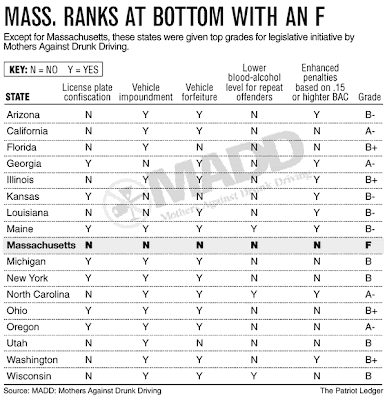
Here are a few quotes from this series:
* Massachusetts is the worst in the nation at finding out who’s been drinking, driving and causing deadly crashes. - http://www.southofboston.net/specialreports/drunkendriving/111806a.shtml
* Surviving drivers were tested in only five of 296 fatal crashes in Massachusetts last year. That's 1.7 percent, lowest in the country. According to the National Highway Traffic Safety Administration, the national average was 31 percent.
The federal agency has pushed for years to test all drivers involved in deadly accidents. But nine states, including Massachusetts, still do not require or even recommend blood-alcohol testing of surviving drivers in fatal crashes.
Massachusetts tests nine out of 10 victims of fatal crashes as part of routine autopsies. -
http://www.southofboston.net/specialreports/drunkendriving/111806a.shtml
* Flunking the test: Mass. policy is nation's most lax
Massachusetts has no law requiring alcohol testing, but five other states do.Drivers involved in fatal accidents in New Hampshire have no right to refuse blood-alcohol tests if they’re suspected of causing the crash.
“The officer can actually, if need be, restrain the person physically while the blood is being withdrawn,” said Earl Sweeney, assistant commissioner of public safety in New Hampshire.
Maine has the same policy, but it applies to all fatal accidents regardless of who’s at fault.
“We test anybody in a serious accident where death occurs or is likely to occur,” said Kennebec County District Attorney Evert Fowle, head of the Maine Prosecutors Association. “It’s certainly called for by the law, and we do it.”
Maine tests 77 percent of drivers involved in fatal crashes, second only to South Carolina’s 94 percent. New Hampshire tested 32 percent, slightly above the national average.
But in Massachusetts, police can ask drivers to take a test only after they’ve been arrested for drunk driving. Here, the number tested is less than 2 percent. No other state tests so few drivers.
- http://www.southofboston.net/specialreports/drunkendriving/111806a.shtml
* Good lawyers, soft judges: Drunks still drive - No jail time for 85% of those convicted
...and more than two dozen other South Shore drivers who are currently facing their third, fourth, fifth, even eighth drunken driving offenses.
Why are they still on the road?
Prosecutors, police and anti-drunken driving advocates say the answer lies in a 10,000-word state law that treats drunken driving as a petty crime, gives judges wide latitude in sentencing and allows even chronic drunken drivers to claim hardship to get their licenses back. An overloaded court system, cutbacks in alcohol treatment and a Legislature reluctant to adopt tougher sentencing mandates also contribute to the problem, they say.
All of this has combined to give Massachusetts one of the nation's worst track records for dealing with drunken drivers, both first-time and habitual offenders.
Consider the statistics:
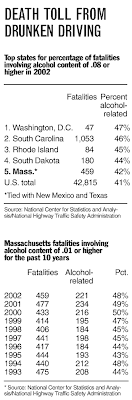
- Federal highway safety reports show that only four states have a greater percentage of alcohol-related fatalities than Massachusetts.
- While the percentage of fatalities caused by drunken driving has declined nationally during the past 20 years, Massachusetts' has declined at a lower rate than the national average, and only marginally since 1993.
- Massachusetts received a D-minus last year from Mothers Against Drunk Driving. The only lower grade was Montana's F.
- Faced with the loss of federal highway money, Massachusetts this year became the last state in the nation to adopt the so-called "per se" law, which defines a blood-alcohol level of .08 as irrefutable proof in court that a person is legally drunk.
- http://www.southofboston.net/specialreports/drunkendriving/1a.shtml
* Federal studies estimate that drunken driving costs the United States $114 billion a year in medical expenses, lost wages and decreased quality of life. Massachusetts' share of that bill is $1.8 billion.
The statistics obscure a compound tragedy experienced by many victims and families: often the auto insurance carried by the drunken driver, or by the victims, is totally inadequate to cover the costs.
Repeat offenders who have lost their license may have no insurance at all, forcing victims to rely only on their own. In any case, victims sometimes face years of litigation to recoup some of their costs.
- http://www.southofboston.net/specialreports/drunkendriving/2a.shtml
Graphics from "Driving to Endanger" - Patriot Ledger Series
Wednesday, March 21, 2007
Melanie's Law - Massachusetts OUI Law Changes
The following is from a website that is set up by a law firm that defends DWI/DUI/OUI Drivers, http://www.madrunkdrivingdefense.com/melanieslaw.htm - Sue
Melanie's Law - Massachusetts OUI Law Changes
Massachusetts Passed "Melanie's Law" on October 28, 2005
Some of the new changes to Massachusetts Drunk Driving / OUI laws are as follows...
For First Offenders (1st Offense) Massachusetts DUI/OUI:
If You Refused the Breath Test:
- No 15 day temporary license
- May impound your car for 12 hours
- License Suspension consecutive with any OUI conviction penalty
- Under 21 Breath Test refusal 1st OUI offense - 3 year license suspension
- The Breath Test refusal penalty is a 180 day license suspension (no change with Melanie's Law, other than the consecutive license suspension)
If you are Found Guilty:
- Under 21 with BAC of over .20 must attend a 14-day second offender in-home program
For Second Offenders (2nd Offense) Massachusetts DUI/OUI:
If You Refused the Breath Test:
- 3 Year License Suspension, consecutive with any OUI conviction penalty
- Under 21 Breath Test refusal 2nd OUI offense - 5 year license suspension
If you are Found Guilty:
- Not eligible for work/school hardship license for 1 year (+3 additional years of if you refused the breath test)
- As of 1/1/06, Ignition Interlock device installed in your car at your own expense for 2 years as a condition of license reinstatement.
For Third Offense (3rd Offense) OUI Massachusetts OUI / Drunk Driving
If You Refused the Breath Test:
- Under 21 Breath Test refusal 3rd OUI offense - Lifetime license suspension
If you are Found Guilty:
- They can seize, keep, and sell your vehicle for a third or subsequent OUI offense..
- Not eligible for work/school hardship license for 2 year (+5 additional years of if you refused the breath test)
- The Registry may cancel your registration while your license is suspended for a third or subsequent OUI offense.
New OUI Related Laws
- If you live outside of Massachusetts, you may take an eligible treatment program in your state as part of your penalty.
- Committing OUI-related offenses while having a license suspended or revoked for OUI-related reasons (OUI, vehicular homicide, OUI with serious injury, OUI or homicide in a boat, or vehicular manslaughter) Penalty for conviction - mandatory minimum sentence of 1 year, to be served consecutively to any other sentence.
- Your vehicle may be forfeited for a 4th (fourth) offense OUI or subsequent offense.
- Child Endangerment by Operating Under the Influence - If you are convicted of an OUI while a child under 14 is in the car, their is an additional penalty of a license loss of 1 year (consecutive with any other license loss period). Mandatory 6 months in jail for a 2nd offense, and a 3 year license loss (consecutive)
Other Related New Laws
Tuesday, March 20, 2007
Massachusetts Homicide and Vehicular Homicide Laws
Sorry for the delay in posting...I tripped a couple of days ago and broke a couple of bones in my right hand (sigh) so typing is going a bit slow. The knuckles where my little finger and my ring finger attach to my hand are a bit "mashed". I guess my brother and I have the same Klutz gene...he broke fingers and knuckles on the same hand about 4 weeks ago.
I've received some more response to my letters and phone calls regarding strengthening the repeat offender DWI/DUI/OUI laws (they all have the same meaning according to Mass. law). In addition to hearing back from MA Rep. Jeffrey Perry and MA State Senator Mark Montigney I have also received a letter from Vice President Cheney and the MA State Attorney General. Today I have a message on my answering machine to return a call from Sen. John Kerry's office.
A Brief Overview of Massachusetts Homicide Law
Massachusetts law defines a homicide as the willful (non-negligent) killing of one human being by another. There are two categories of criminal homicide under Massachusetts law-murder and manslaughter. There are also different classifications of murder and manslaughter. Which homicide crime has been committed (and the punishment that can or must be imposed) generally depends on the manner in which the crime was committed and the intent on the part of the perpetrator.
Classifications of Murder / Punishment
First Degree Murder / Life, without possibility of parole
Second Degree Murder / Life, parole elegibility after 15 years
Classifications of Manslaughter / Punishment
Voluntary Manslaughter / State prison up to 20 years; plus fines
Involuntary Manslaughter / State prison up to 20 years; plus fines
Vehicular Homicide / State prison up to 20 years; plus fines
A Brief Overview of Massachusetts Vehicular Homicide Law
(Melanie's Law increased the mandatory minimum, more info in next post-Sue)
Vehicular Homicide While Operating Under the Influence of Alcohol or Other Drugs and While Operating To Endanger = Mandatory minimum 2 ½ years and up to 15 years in state prison or mandatory minimum 1 year and up to 2 ½ years in jail; plus fines*
Vehicular Homicide While Operating Under the Influence of Alcohol or Other Drugs or While Operating To Endanger = Mandatory minimum 30 days and up to 2 1/2 years in jail; plus fines*
*Also loss of license
Massachusetts Vehicular Homicide Statistics (1998):
1998 alcohol-related statistics for Massachusetts
All traffic fatalities/Alcohol-related fatalities/% Alcohol-related
406 / 192 / 47.4*%
Statistics from National Highway Traffic Safety Administration (NHTSA)
National Vehicular Homicide Trends - According to the National Highway Transportation Safety Administration (NHTSA):
* More than 35% of all 16-to-20 year-old deaths result from motor vehicle crashes.
* 37% of these motor vehicle fatalaties were alcohol-related crashes.
* The troubling news: During a typical weekend, an average of one teenager dies each hour in a car crash. Car crashes are the #1 cause of death among teens.
* Promising news: Since 1989, less than half of youth motor vehicle fatalities have been alcohol-related.
Sue
I've received some more response to my letters and phone calls regarding strengthening the repeat offender DWI/DUI/OUI laws (they all have the same meaning according to Mass. law). In addition to hearing back from MA Rep. Jeffrey Perry and MA State Senator Mark Montigney I have also received a letter from Vice President Cheney and the MA State Attorney General. Today I have a message on my answering machine to return a call from Sen. John Kerry's office.
The following information is from the Norfolk County Massachusetts District Attorney's website
A Brief Overview of Massachusetts Homicide Law
Massachusetts law defines a homicide as the willful (non-negligent) killing of one human being by another. There are two categories of criminal homicide under Massachusetts law-murder and manslaughter. There are also different classifications of murder and manslaughter. Which homicide crime has been committed (and the punishment that can or must be imposed) generally depends on the manner in which the crime was committed and the intent on the part of the perpetrator.
Classifications of Murder / Punishment
First Degree Murder / Life, without possibility of parole
Second Degree Murder / Life, parole elegibility after 15 years
Classifications of Manslaughter / Punishment
Voluntary Manslaughter / State prison up to 20 years; plus fines
Involuntary Manslaughter / State prison up to 20 years; plus fines
Vehicular Homicide / State prison up to 20 years; plus fines
A Brief Overview of Massachusetts Vehicular Homicide Law
(Melanie's Law increased the mandatory minimum, more info in next post-Sue)
Vehicular Homicide While Operating Under the Influence of Alcohol or Other Drugs and While Operating To Endanger = Mandatory minimum 2 ½ years and up to 15 years in state prison or mandatory minimum 1 year and up to 2 ½ years in jail; plus fines*
Vehicular Homicide While Operating Under the Influence of Alcohol or Other Drugs or While Operating To Endanger = Mandatory minimum 30 days and up to 2 1/2 years in jail; plus fines*
*Also loss of license
Massachusetts Vehicular Homicide Statistics (1998):
1998 alcohol-related statistics for Massachusetts
All traffic fatalities/Alcohol-related fatalities/% Alcohol-related
406 / 192 / 47.4*%
Statistics from National Highway Traffic Safety Administration (NHTSA)
National Vehicular Homicide Trends - According to the National Highway Transportation Safety Administration (NHTSA):
* More than 35% of all 16-to-20 year-old deaths result from motor vehicle crashes.
* 37% of these motor vehicle fatalaties were alcohol-related crashes.
* The troubling news: During a typical weekend, an average of one teenager dies each hour in a car crash. Car crashes are the #1 cause of death among teens.
* Promising news: Since 1989, less than half of youth motor vehicle fatalities have been alcohol-related.
Sue
Friday, March 16, 2007
www.JusticeForDiane.com
To make it easier to find this site, and since I have found that Google is now listing us in the blog search and not their regular internet search, I have set up www.JusticeForDiane.com which will bring you right to this site. If you have already bookmarked this site or saved it to your favorites, do not worry, you will still be brought right to the home page as usual.
Sue
Sue
Wednesday, March 14, 2007
Christopher G. Parker has a spotty driving record going back to 1982
The following information was included in the Cape Cod Times March 14, 2007 article titled "Crash spurs fresh call for tougher state laws" written by reporter George Brennan. The full article can be found in the links section on the left side of this site. I am shocked that Christopher G. Parker hasn't been incarcerated before this time.
As you read through this list of offenses and convictions I hope you share my shock that this man was even allowed out of prison..and he is still out on the streets! Who will his reckless actions affect next? I have learned Mr. Parker has a young son. Mr Parker's irresponsible actions not only took my mother's life and caused injuries to the driver of the NStar truck but his son will grow up without a father if we are successful in placing Mr Parker behind bars.
Please think of the total consequences if you are tempted to drink or use drugs (illegal or not) and choose to drive while you are impaired in any way. This record goes to show once again the total lack of respect that Christopher G. Parker has for anything or anyone except himself. I guess he believes that the laws of the State of Massachusetts apply to everyone except himself. No wonder he didn't seem too upset while he was in court yesterday - he is a pro at this!
May 21, 1982: Charged with operating under the influence of alcohol, West Bridgewater. Convicted Dec. 17, 1982.
Sept. 28, 1982: Charged with operating under the influence of alcohol, Hingham. Convicted Dec. 17, 1982. Ordered to attend alcohol treatment program.
April 6, 1998: Charged with operating under the influence of alcohol, Sandwich. Convicted June 29, 1998. Ordered to attend 45 day treatment program.
March 21, 1999: Charged with operating under the influence of alcohol, Sandwich. Convicted
April 20, 1999. License revoked for two years and ordered to attend alcohol treatment program.
June 14, 2002: Charged with operating under the influence of drugs, Sandwich. Dismissed June 12, 2003.
Over the past 25 years, he has also been cited for speeding five times, causing an accident once and driving without an inspection sticker once.
Source: Registry of Motor Vehicles
As you read through this list of offenses and convictions I hope you share my shock that this man was even allowed out of prison..and he is still out on the streets! Who will his reckless actions affect next? I have learned Mr. Parker has a young son. Mr Parker's irresponsible actions not only took my mother's life and caused injuries to the driver of the NStar truck but his son will grow up without a father if we are successful in placing Mr Parker behind bars.
Please think of the total consequences if you are tempted to drink or use drugs (illegal or not) and choose to drive while you are impaired in any way. This record goes to show once again the total lack of respect that Christopher G. Parker has for anything or anyone except himself. I guess he believes that the laws of the State of Massachusetts apply to everyone except himself. No wonder he didn't seem too upset while he was in court yesterday - he is a pro at this!
May 21, 1982: Charged with operating under the influence of alcohol, West Bridgewater. Convicted Dec. 17, 1982.
Sept. 28, 1982: Charged with operating under the influence of alcohol, Hingham. Convicted Dec. 17, 1982. Ordered to attend alcohol treatment program.
April 6, 1998: Charged with operating under the influence of alcohol, Sandwich. Convicted June 29, 1998. Ordered to attend 45 day treatment program.
March 21, 1999: Charged with operating under the influence of alcohol, Sandwich. Convicted
April 20, 1999. License revoked for two years and ordered to attend alcohol treatment program.
June 14, 2002: Charged with operating under the influence of drugs, Sandwich. Dismissed June 12, 2003.
Over the past 25 years, he has also been cited for speeding five times, causing an accident once and driving without an inspection sticker once.
Source: Registry of Motor Vehicles
Tuesday, March 13, 2007
The Media and Christopher G. Parker
Today my Grandmother and I went down to the Falmouth District Courthouse and met with both George Brennan of the Cape Cod times and the cameraman from WHDH, NBC channel 7 Boston. We did not go into the courtroom, as we had no wish to see Mr. Parker. While we were there waiting for Mr. Brennan we saw a man come out of the courtroom with his head down and he was walking quickly towards the door. It wasn't until we saw the print photographers and cameraman from channel 7 following quickly behind the man that we realized that this might be Mr Parker. I followed them outside, just to see what was going to happen, and stood with two officers from the courthouse. What a sight to see with Mr Parker walking as fast as he could down the road and the cameraman and photographers following and running in front of him then turning back to take his picture! It was like a mini paparazzi event. I have posted the article that Mr Brennan has written this afternoon. It is listed in the links section at left under "Driver cries about last weeks fatality".
Afterward we went back to Mattapoisett and met with Byron Barnett, the reporter from channel 7. The piece will run sometime today between 4 - 6:30 and then most likely at 11pm.
 Just after the crew from channel 7 left I recieved a call from Shirley Chan, a reporter from Fox News 25, in Boston. They also came by and interviewed for a piece on this site, Justice for Diane. They didn't have time to get back to Boston before they had to go on the air at 5pm so they met a satellite truck at the Mattapoisett Police Station in order to be able to send the story feed. This story will air tonight at 5pm and then a longer piece at 10pm on channel 25. I also hear that the Cape Cod Times has been contacted by several media outlets asking for pictures of my mother and the vehicles involved.
To say that I am humbled by the support that we have received in such a short time is an understatement. My mother always said that one person can make a change and I used to think that it was impossible...now I'm beginning to have a bit of hope that we WILL be able to make a difference in the name of my mom, Diane "Dee" Louise Kelsey Everett Carhart.
Afterward we went back to Mattapoisett and met with Byron Barnett, the reporter from channel 7. The piece will run sometime today between 4 - 6:30 and then most likely at 11pm.
 Just after the crew from channel 7 left I recieved a call from Shirley Chan, a reporter from Fox News 25, in Boston. They also came by and interviewed for a piece on this site, Justice for Diane. They didn't have time to get back to Boston before they had to go on the air at 5pm so they met a satellite truck at the Mattapoisett Police Station in order to be able to send the story feed. This story will air tonight at 5pm and then a longer piece at 10pm on channel 25. I also hear that the Cape Cod Times has been contacted by several media outlets asking for pictures of my mother and the vehicles involved.
To say that I am humbled by the support that we have received in such a short time is an understatement. My mother always said that one person can make a change and I used to think that it was impossible...now I'm beginning to have a bit of hope that we WILL be able to make a difference in the name of my mom, Diane "Dee" Louise Kelsey Everett Carhart.
Monday, March 12, 2007
Media Stories Regarding Diane's Tragic Death
UPDATE -> I have also been contacted by Shirley Chan at Fox News, Channel 25 in Boston. Somehow they have heard about "Justice for Diane".
--------
I have been contacted by both WHDH, NBC channel 7 in Boston, MA, and George Brennan a reporter from the Cape Cod Times who has been covering this story. My Grandmother, a neighbor of my mother's and myself will be meeting with them both tomorrow morning for stories that will run on channel 7 tomorrow, Tuesday March 13, 2007 and in the Times over the following days. I will post more info on exactly when the stories will run as soon as I am able.
The fact that Mr. Parker has such an extensive driving record with the court system really gets people to sit up and take notice, as it should. It is our hope that as others are made aware of the lax sentences handed out to repeat DWI offenders, as well as for charges of Vehicular Homicide, that we will be able to have our collective voices heard loud and clear...thus getting "Justice for Diane".
Sue
--------
I have been contacted by both WHDH, NBC channel 7 in Boston, MA, and George Brennan a reporter from the Cape Cod Times who has been covering this story. My Grandmother, a neighbor of my mother's and myself will be meeting with them both tomorrow morning for stories that will run on channel 7 tomorrow, Tuesday March 13, 2007 and in the Times over the following days. I will post more info on exactly when the stories will run as soon as I am able.
The fact that Mr. Parker has such an extensive driving record with the court system really gets people to sit up and take notice, as it should. It is our hope that as others are made aware of the lax sentences handed out to repeat DWI offenders, as well as for charges of Vehicular Homicide, that we will be able to have our collective voices heard loud and clear...thus getting "Justice for Diane".
Sue
Subscribe to:
Posts (Atom)