In order to be able to get an idea of what people are thinking in regards to various Massachusetts laws relating to repeat offenders, operating under the influence of drugs or alcohol, vehicular homicide, and concurrent sentencing I will be putting a few polls up, located just under Diane's picture at left.
Polls will generally last for 30 days or longer.
All votes are anonymous and while you can only vote once, you can go back and change that vote.
Please take the time to vote.
Within the week I will be putting up a link to an online petition too. Be sure to check back as we start phase two of this site. Now that Parker has been sentenced and sent to jail (too briefly in my opinion) I will Begin to work in earnest to bring our motor vehicle laws in line with most other states. At this time Massachusetts is losing out on Federal funding because the driving laws are not in line with federal guidelines - Lets do something to fix that!
Showing posts with label Justice for Diane. Show all posts
Showing posts with label Justice for Diane. Show all posts
Saturday, July 28, 2007


Wednesday, March 28, 2007
Change of Falmouth District Court Date
Christopher G. Parker's court date of March 30, 2007 in Falmouth District Court, where he was to appear on charges of driving under the influence of drugs this past October, has been continued until April 27, 2007 at 9:00am at the request of his Attorney.
Monday, March 26, 2007
Magistrate Hearings
Several people have asked me what exactly a magistrate hearing is and what will happen afterward. I did a little research and this is what I found out:
When you are given a traffic citation you will notice a box for civil offenses and a box for criminal offenses.
If the box for civil (say for a speeding charge) is checked that means you have 20 days in which you can return the citation and request a magistrate hearing. At this magistrate hearing you will listen to the charge against you read and then the police officer will present the case against you to the clerk magistrate. You will either have the citation dismissed, receive a lesser charge/payment penalty, or be found guilty and responsible to pay the original penalty fee, usually with resulting insurance points added as well.
If the box for criminal (perhaps a vehicular homicide charge) is checked this means you have only 4 days in which to return the citation to the magistrate's office to request a hearing. At this magistrate hearing you will listen to the charges against you read aloud and then a bit of the case against you will be presented to show why you should be charged. The magistrate will either dismiss the charge/charges, continue the case (you will not be charged unless you are charged with another offense), or if probable cause is found a complaint will be issued by the court for you to appear before a judge for arraignment. If you receive a criminal citation and don't request a Clerk Magistrate's hearing a complaint will be automatically issued and you will receive a summons to appear before a judge for an arraignment.
The arraignment usually happens within the next 48 hours, depending on the case load of the particular court. At the arraignment the District Attorney or Assistant District Attorney may request bail or that you are not released on bail, depending on the charges against you and any prior convictions.
In certain circumstances, the District Attorney's office can proceed by way of a grand jury which can vote on indictments against you. If you are indicted you will move from the District Court level to the Superior Court where the potential for heavier penalties and longer incarcerations exists, in the State Penatentiary instead of the House of Correction.
It should be noted that in spite of the public records laws Magistrate Hearings are closed to the public in the State of Massachusetts, the only state in the U.S. where this happens. The results are only known if the magistrate decides to file charges, and then only through court records. The Mass. State law presumes that magistrate's hearings are closed unless the public or newspapers can convince the court otherwise. The Cape Cod Times states: "While the public records law does require agencies to presume all documents are public and to prove why records should not be released, the trend is the opposite. Increasingly, the public and newspapers are being forced to prove why records are public. In some cases, it takes appeals to the secretary of state's office or, ultimately, taking the agency to court."
Sue
Ref.
- Mass. RMV Drivers Manuel
- Arlington, MA Police FAQ
- Criminal Process - masscriminal-lawyers.com
- Despite laws, government secrecy grows By George Brennan staff writer Cape Cod Times
Sunday, March 25, 2007
Justice For Diane MySpace Page
At the request of a couple of friends I have set up a MySpace site to try to get the word out and bring even more traffic to this site. You will find a link in the side bar at left. If you or someone you know has a MySpace page feel free to add our new page to your friends list and also send the link to anyone who also has a MySpace page. A number of the elected officials that I have been in contact with also have MySpace pages and hopefully they will add our page to their friends too. I'm going to use the MySpace blog to list updates made to this site.
Friday, March 23, 2007
Statistics from M.A.D.D.
- Alcohol is closely linked with violence. About 40 percent of all crimes (violent and non-violent) are committed under the influence of alcohol. (Bureau of Justice Statistics, 1998)
- About three in every ten Americans will be involved in an alcohol-related crash at some time in their lives. (NHTSA, 2001)
- above from http://www.madd.org/stats/1789
- Fatally injured drivers with BAC levels of 0.08 g/dl or greater were 9 times as likely to have a prior conviction for driving while intoxicated compared to fatally injured sober drivers. (NHTSA, 2004).
- The risk of a driver who has one or more DWI convictions becoming involved in a fatal crash is about 1.4 times the risk of a driver with no DWI conviction. (NHTSA, 2000)
- About one-third of all drivers arrested or convicted of driving while intoxicated or driving under the influence of alcohol are repeat offenders. (Fell, 1995)
- above from http://www.madd.org/stats/4542
Higher-Risk Drivers: The Problem
Higher-Risk Driver: MADD defines the “higher-risk driver” as 1) Repeat offenders convicted (conviction is defined as receiving a court-imposed sanction) of a second driving-under-the-influence offense within a 5- year period; 2) High BAC offenders convicted of a driving-under-the-influence offense with a BAC of .15% or higher; and/or 3) Driving-while-suspended (DWS) where the suspension was the result of a conviction for driving under the influence.
THE PROBLEM
Repeat Offenders:
- About one-third of all drivers arrested or convicted of driving under the influence are repeat offenders. These drivers are 40% more likely to be involved in a fatal crash than those without prior DUIs.
High-BAC Offenders:
- Over half of alcohol-related traffic fatalities involve drivers with a BAC of .15% and above.2 These drivers are at least 382 times more likely to be involved in a fatal crash than a non-drinking driver.
- During a typical weekend night, 1% of drivers will have a blood alcohol concentration (BAC) of .15 or higher.
Offenders Who Drive on a Suspending License:
- 50-75% of drunk drivers whose licenses are suspended continue to drive.
- 32% of suspended second-time offenders and 61% of suspended third-time offenders received violations or were involved in crashes during their suspensions.
- Generally, unlicensed drivers are 4.9 times more likely to be involved in a fatal crash than properly licensed drivers.
- above from http://www.madd.org/stats/11001
- Impaired driving is the most frequently committed violent crime in the United States.
- About one-third of all drivers arrested or convicted of driving while intoxicated or driving under the influence of alcohol (DWI) have a previous DWI conviction.
- Drivers with prior DWI convictions are over-represented in fatal crashes and have a greater relative risk of
- Between 50 and 75 percent of those whose licenses are suspended due to a DUI continue to drive illegally. Over 60 percent of 3rd time DUI offenders, who have their license suspended, commit some manner of traffic violation during their suspension/revocation period.
- above from http://www.madd.org/news/9856
Thursday, March 22, 2007
Forestdale man charged with vehicular homicide
UPDATE: The Magistrate's Hearing on the charges of vehicular homicide due to negligence as well as driving on a revoked license that Christopher G. Parker has requested will be held on Wednesday April 4, 2007 at 2:00pm at the Barnstable District Court House on Cape Cod. Directions are located here. Please contact me if you plan to attend.
Forestdale man charged with vehicular homicide
By GEORGE BRENNAN STAFF WRITER SANDWICH - Christopher G. Parker was issued a citation this week charging him with vehicular homicide in the March 5 death of Diane Carhart, the police said.
Parker, 50, of Forestdale, was also cited for driving with a revoked license.
The citation makes official what police have said since shortly after the three-car crash on Route 130: They believe Parker was responsible for causing the fatal wreck.
There are indications Parker requested a hearing before a clerk-magistrate, as is his right, but no date has been set, according to a Barnstable District Court clerk.
Parker has a lengthy driving infraction record, which includes four drunken driving convictions, dating back to 1982. He also has a case pending in Falmouth District Court on a charge of operating a motor vehicle while under the influence of drugs in October in Bourne.
Not only had his license been revoked at the time of the Sandwich crash because state police considered him an ''immediate danger,” but his license had also been suspended for failure to pay a speeding ticket, Massachusetts Registry of Motor Vehicle records indicate.
Police have not cited Parker for operating under the influence in connection with Carhart's death but have said the investigation of the crash continues and more charges could follow.
Had Parker waived his right to a magistrate's hearing, a date would have been set for an arraignment in Barnstable District Court.
In a magistrate's hearing, the clerk will decide whether police have shown probable cause for the charge to be pursued in district court. If probable cause is established, an arraignment will be scheduled, but the magistrate also has the authority to dismiss the criminal complaint.
Magistrate hearings are typically closed to the public.
During a court appearance last week on the Bourne charge, Parker was issued a warning by a judge that if he was charged with any other crime his $1,000 bail could be revoked and he could be jailed for up to 60 days.
He had not been officially charged in the fatal three-car crash at the time of his hearing last week.
George Brennan can be reached at gbrennan@capecodonline.com.
(Published: March 22, 2007)
Driving to Endanger - Patriot Ledger Series
I found a series of articles regarding DWI, Melanie's Law and the laws in Massachusetts that was run in the Patriot Ledger over the last few years. I have put a link in the links section at left to a page of this series that covers how Mass. is lagging behind other states in their DWI laws and convictions. As you read through these quotes and graphics I hope you will follow the links to read through this whole series. Only by making others aware of the lax laws in Massachusetts can we make a change. How can a state that is as pro-active as Massachusetts have such archaic laws as they apply to drunk or drugged driving and repeat offenders who obviously have no respect for the law and will not be rehabilitated. We allow Gay marriage (the only state to do so) and fight for the rights of illegal immigrants (they are here illegally), but will not keep people who abuse the law repeatedly off the streets - something just isn't right here!
Here are a few quotes from this series:
* Massachusetts is the worst in the nation at finding out who’s been drinking, driving and causing deadly crashes. - http://www.southofboston.net/specialreports/drunkendriving/111806a.shtml
* Surviving drivers were tested in only five of 296 fatal crashes in Massachusetts last year. That's 1.7 percent, lowest in the country. According to the National Highway Traffic Safety Administration, the national average was 31 percent.
The federal agency has pushed for years to test all drivers involved in deadly accidents. But nine states, including Massachusetts, still do not require or even recommend blood-alcohol testing of surviving drivers in fatal crashes.
Massachusetts tests nine out of 10 victims of fatal crashes as part of routine autopsies. -
http://www.southofboston.net/specialreports/drunkendriving/111806a.shtml
* Flunking the test: Mass. policy is nation's most lax
Massachusetts has no law requiring alcohol testing, but five other states do.Drivers involved in fatal accidents in New Hampshire have no right to refuse blood-alcohol tests if they’re suspected of causing the crash.
“The officer can actually, if need be, restrain the person physically while the blood is being withdrawn,” said Earl Sweeney, assistant commissioner of public safety in New Hampshire.
Maine has the same policy, but it applies to all fatal accidents regardless of who’s at fault.
“We test anybody in a serious accident where death occurs or is likely to occur,” said Kennebec County District Attorney Evert Fowle, head of the Maine Prosecutors Association. “It’s certainly called for by the law, and we do it.”
Maine tests 77 percent of drivers involved in fatal crashes, second only to South Carolina’s 94 percent. New Hampshire tested 32 percent, slightly above the national average.
But in Massachusetts, police can ask drivers to take a test only after they’ve been arrested for drunk driving. Here, the number tested is less than 2 percent. No other state tests so few drivers.
- http://www.southofboston.net/specialreports/drunkendriving/111806a.shtml
* Good lawyers, soft judges: Drunks still drive - No jail time for 85% of those convicted
...and more than two dozen other South Shore drivers who are currently facing their third, fourth, fifth, even eighth drunken driving offenses.
Why are they still on the road?
Prosecutors, police and anti-drunken driving advocates say the answer lies in a 10,000-word state law that treats drunken driving as a petty crime, gives judges wide latitude in sentencing and allows even chronic drunken drivers to claim hardship to get their licenses back. An overloaded court system, cutbacks in alcohol treatment and a Legislature reluctant to adopt tougher sentencing mandates also contribute to the problem, they say.
All of this has combined to give Massachusetts one of the nation's worst track records for dealing with drunken drivers, both first-time and habitual offenders.
Consider the statistics:
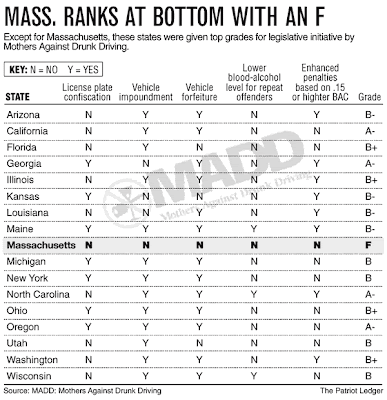
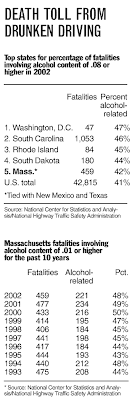
Here are a few quotes from this series:
* Massachusetts is the worst in the nation at finding out who’s been drinking, driving and causing deadly crashes. - http://www.southofboston.net/specialreports/drunkendriving/111806a.shtml
* Surviving drivers were tested in only five of 296 fatal crashes in Massachusetts last year. That's 1.7 percent, lowest in the country. According to the National Highway Traffic Safety Administration, the national average was 31 percent.
The federal agency has pushed for years to test all drivers involved in deadly accidents. But nine states, including Massachusetts, still do not require or even recommend blood-alcohol testing of surviving drivers in fatal crashes.
Massachusetts tests nine out of 10 victims of fatal crashes as part of routine autopsies. -
http://www.southofboston.net/specialreports/drunkendriving/111806a.shtml
* Flunking the test: Mass. policy is nation's most lax
Massachusetts has no law requiring alcohol testing, but five other states do.Drivers involved in fatal accidents in New Hampshire have no right to refuse blood-alcohol tests if they’re suspected of causing the crash.
“The officer can actually, if need be, restrain the person physically while the blood is being withdrawn,” said Earl Sweeney, assistant commissioner of public safety in New Hampshire.
Maine has the same policy, but it applies to all fatal accidents regardless of who’s at fault.
“We test anybody in a serious accident where death occurs or is likely to occur,” said Kennebec County District Attorney Evert Fowle, head of the Maine Prosecutors Association. “It’s certainly called for by the law, and we do it.”
Maine tests 77 percent of drivers involved in fatal crashes, second only to South Carolina’s 94 percent. New Hampshire tested 32 percent, slightly above the national average.
But in Massachusetts, police can ask drivers to take a test only after they’ve been arrested for drunk driving. Here, the number tested is less than 2 percent. No other state tests so few drivers.
- http://www.southofboston.net/specialreports/drunkendriving/111806a.shtml
* Good lawyers, soft judges: Drunks still drive - No jail time for 85% of those convicted
...and more than two dozen other South Shore drivers who are currently facing their third, fourth, fifth, even eighth drunken driving offenses.
Why are they still on the road?
Prosecutors, police and anti-drunken driving advocates say the answer lies in a 10,000-word state law that treats drunken driving as a petty crime, gives judges wide latitude in sentencing and allows even chronic drunken drivers to claim hardship to get their licenses back. An overloaded court system, cutbacks in alcohol treatment and a Legislature reluctant to adopt tougher sentencing mandates also contribute to the problem, they say.
All of this has combined to give Massachusetts one of the nation's worst track records for dealing with drunken drivers, both first-time and habitual offenders.
Consider the statistics:
- Federal highway safety reports show that only four states have a greater percentage of alcohol-related fatalities than Massachusetts.
- While the percentage of fatalities caused by drunken driving has declined nationally during the past 20 years, Massachusetts' has declined at a lower rate than the national average, and only marginally since 1993.
- Massachusetts received a D-minus last year from Mothers Against Drunk Driving. The only lower grade was Montana's F.
- Faced with the loss of federal highway money, Massachusetts this year became the last state in the nation to adopt the so-called "per se" law, which defines a blood-alcohol level of .08 as irrefutable proof in court that a person is legally drunk.
- http://www.southofboston.net/specialreports/drunkendriving/1a.shtml
* Federal studies estimate that drunken driving costs the United States $114 billion a year in medical expenses, lost wages and decreased quality of life. Massachusetts' share of that bill is $1.8 billion.
The statistics obscure a compound tragedy experienced by many victims and families: often the auto insurance carried by the drunken driver, or by the victims, is totally inadequate to cover the costs.
Repeat offenders who have lost their license may have no insurance at all, forcing victims to rely only on their own. In any case, victims sometimes face years of litigation to recoup some of their costs.
- http://www.southofboston.net/specialreports/drunkendriving/2a.shtml
Graphics from "Driving to Endanger" - Patriot Ledger Series
Wednesday, March 21, 2007
Melanie's Law - Massachusetts OUI Law Changes
The following is from a website that is set up by a law firm that defends DWI/DUI/OUI Drivers, http://www.madrunkdrivingdefense.com/melanieslaw.htm - Sue
Melanie's Law - Massachusetts OUI Law Changes
Massachusetts Passed "Melanie's Law" on October 28, 2005
Some of the new changes to Massachusetts Drunk Driving / OUI laws are as follows...
For First Offenders (1st Offense) Massachusetts DUI/OUI:
If You Refused the Breath Test:
- No 15 day temporary license
- May impound your car for 12 hours
- License Suspension consecutive with any OUI conviction penalty
- Under 21 Breath Test refusal 1st OUI offense - 3 year license suspension
- The Breath Test refusal penalty is a 180 day license suspension (no change with Melanie's Law, other than the consecutive license suspension)
If you are Found Guilty:
- Under 21 with BAC of over .20 must attend a 14-day second offender in-home program
For Second Offenders (2nd Offense) Massachusetts DUI/OUI:
If You Refused the Breath Test:
- 3 Year License Suspension, consecutive with any OUI conviction penalty
- Under 21 Breath Test refusal 2nd OUI offense - 5 year license suspension
If you are Found Guilty:
- Not eligible for work/school hardship license for 1 year (+3 additional years of if you refused the breath test)
- As of 1/1/06, Ignition Interlock device installed in your car at your own expense for 2 years as a condition of license reinstatement.
For Third Offense (3rd Offense) OUI Massachusetts OUI / Drunk Driving
If You Refused the Breath Test:
- Under 21 Breath Test refusal 3rd OUI offense - Lifetime license suspension
If you are Found Guilty:
- They can seize, keep, and sell your vehicle for a third or subsequent OUI offense..
- Not eligible for work/school hardship license for 2 year (+5 additional years of if you refused the breath test)
- The Registry may cancel your registration while your license is suspended for a third or subsequent OUI offense.
New OUI Related Laws
- If you live outside of Massachusetts, you may take an eligible treatment program in your state as part of your penalty.
- Committing OUI-related offenses while having a license suspended or revoked for OUI-related reasons (OUI, vehicular homicide, OUI with serious injury, OUI or homicide in a boat, or vehicular manslaughter) Penalty for conviction - mandatory minimum sentence of 1 year, to be served consecutively to any other sentence.
- Your vehicle may be forfeited for a 4th (fourth) offense OUI or subsequent offense.
- Child Endangerment by Operating Under the Influence - If you are convicted of an OUI while a child under 14 is in the car, their is an additional penalty of a license loss of 1 year (consecutive with any other license loss period). Mandatory 6 months in jail for a 2nd offense, and a 3 year license loss (consecutive)
Other Related New Laws
Friday, March 16, 2007
www.JusticeForDiane.com
To make it easier to find this site, and since I have found that Google is now listing us in the blog search and not their regular internet search, I have set up www.JusticeForDiane.com which will bring you right to this site. If you have already bookmarked this site or saved it to your favorites, do not worry, you will still be brought right to the home page as usual.
Sue
Wednesday, March 14, 2007
Christopher G. Parker has a spotty driving record going back to 1982
The following information was included in the Cape Cod Times March 14, 2007 article titled "Crash spurs fresh call for tougher state laws" written by reporter George Brennan. The full article can be found in the links section on the left side of this site. I am shocked that Christopher G. Parker hasn't been incarcerated before this time.
As you read through this list of offenses and convictions I hope you share my shock that this man was even allowed out of prison..and he is still out on the streets! Who will his reckless actions affect next? I have learned Mr. Parker has a young son. Mr Parker's irresponsible actions not only took my mother's life and caused injuries to the driver of the NStar truck but his son will grow up without a father if we are successful in placing Mr Parker behind bars.
Please think of the total consequences if you are tempted to drink or use drugs (illegal or not) and choose to drive while you are impaired in any way. This record goes to show once again the total lack of respect that Christopher G. Parker has for anything or anyone except himself. I guess he believes that the laws of the State of Massachusetts apply to everyone except himself. No wonder he didn't seem too upset while he was in court yesterday - he is a pro at this!
May 21, 1982: Charged with operating under the influence of alcohol, West Bridgewater. Convicted Dec. 17, 1982.
Sept. 28, 1982: Charged with operating under the influence of alcohol, Hingham. Convicted Dec. 17, 1982. Ordered to attend alcohol treatment program.
April 6, 1998: Charged with operating under the influence of alcohol, Sandwich. Convicted June 29, 1998. Ordered to attend 45 day treatment program.
March 21, 1999: Charged with operating under the influence of alcohol, Sandwich. Convicted
April 20, 1999. License revoked for two years and ordered to attend alcohol treatment program.
June 14, 2002: Charged with operating under the influence of drugs, Sandwich. Dismissed June 12, 2003.
Over the past 25 years, he has also been cited for speeding five times, causing an accident once and driving without an inspection sticker once.
Source: Registry of Motor Vehicles
Subscribe to:
Posts (Atom)