Showing posts with label Diane Carhart. Show all posts

Thursday, July 26, 2007

My Victim Impact Statement

Below is my Victim Impact Statement that I read in the courtroom just before Christopher G. Parker was sentenced. While it is directed to the Judge, Parker was standing, looking at the ground with a red face as I read it. When I was done Judge Lynch thanked me for giving them an idea of who Diane, my Mom, was.

Good Afternoon your Honor,

Thank you for giving my brother and me this time to remember our Mother.

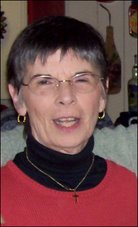
Diane Louise Kelsey Everett Carhart was more then just a name in the newspaper or local television news...the "Forestdale Woman Killed in Accident". She was a loving, caring person who always had a kind word or a helping hand for anyone she met. When asked to give one word to describe her the word "Friend" comes to our minds first, and quickly.

My mother was my best friend. When I was growing up we moved about every 12 to 18 months due to my father's work with the National Marine Fisheries Service. It seemed that I was always the new kid in school. My mother was my closest consistant friend during those years and on into my adulthood. She was my best friend until March 5, 2007 when she was tragically taken from us. While I didn't necessarily see her each and every day, I did speak to her daily. It is so hard for me to realize and comprehend that she is no longer there to answer the phone.

On the morning of March 5th my Mom called me to say what a great time she had had the night before when we had celebrated my Grandmother (Mom's mother)'s 87th birthday. As we talked we made plans to attend a field trial that my dogs were entered in the following weekend in Falmouth. My husband and I do not have children but Mom always enjoyed cheering on her "granddogs" at the events I participate in with them.. After a few minutes of our conversation she said "Goodbye" and hung up the phone, telling me she was going to run a few errands and swing by the Dunkin' Donuts down the road from her home, at Tradewinds Plaze on Route 130.

A short time later I received a very distraught phone call from my brother. "Sue, Mom's dead!" Those words are forever etched into my mind. I initially thought that he was playing a really bad joke on me...I had just talked to Mom, she wasn't dead. Unfortunately as he told me what had happened the awful truth began to sink in. My mother died while waiting to turn into Tradewinds plaza. She was on her way to Dunkin' Donuts to get a vanilla frosted donut with sprinkles and an ice coffee which she would then take down to the water along the Canal in Sandwich. It was her morning routine. She loved watching the boats come through the canal and meeting new people. She died the day after her mother's 87th birthday and was buried a few days later on her brother's 50th birthday. Instead of attending the field trial we had planned on going to the following weekend I was standing next to her closed coffin, greeting people at her wake and funeral.

As I mentioned, my mother was my friend. She was actually much more then that to me as she was my lifeline in many ways. While the death of a mother is one of the hardest things that we as human beings will experience I not only grieve her loss but I also need my mother!

One year ago, not to long after the death of my Mother's husband, my stepfather Lloyd Carhart, I began having problems with my vision. A MRI revealed that I had a meningioma, a benign but fast growing tumor in my head. Due to it's location it had to be removed. My mother changed her entire work schedule, she was manager of the Childrens Gift Shop at Plimoth Plantation, so that she would be able to take me to the many rounds of doctors appointments at Brigham and Woman's hospital. She was with me on August 17th, 2006 as I awoke in the Neurological Intensive Care Unit after undergoing a 9 hour surgery; a left frontal craniotomy with the removal of the bones in my left orbit which were then replaced by titanium mesh.

I stayed at Mom's house for several weeks after I was released from the hospital and she again stayed with me up in Boston when I was readmitted to the hospital due to complications and cognitive problems I was having as a result of the surgery. Mom had been helping me each week with my rehabilitation, relearning many of the things that we all seem to take for granted.
Last month I went back to Brigham and Woman's hospital for my latest 3 month follow-up MRI and then meeting to read the results with my NeuroSurgeon. This was the first time that I went up there without my Mom. To say that I was a bit nervous to go up there by myself is an understatement. You see, there is still a part of the tumor behind my left eye and eventually I will most likely need another craniotomy. My eyesight is getting worse almost daily so I'm nervous that the tumor is growing back faster then the neurosurgeons had hoped. I don't know how I'm going to be able to get through a second brain surgery without my Mom there to make sure that my meds are correct and otherwise see that I'm alright. My husband is a long-haul trucker so he is gone during the week. I NEED my mother and I am scared about life without her. I need her humor and guidence when I am depressed. Additionally, while it embarrasses me a bit to say it, my mother was helping us out financially by helping to pay the mortgage on our house, paying my numerous perscriptions and providing me with the use of my Stepfather's car due to the fact that I have been out of work for almost a year now because of my health. I don't know what I will do or how I will get through it all now.

Since my mother's death I've also had the return of the migraine headaches that preceeded my surgery. I can not sleep longer then two or three hours at a stretch. I have been diagnosed with fibromyalgia, an auto-immune disease that can be triggered by stress, major surgery or shock. I have frequent panic attacks, especially when I go to the phone to call my Mom and realize half way through dialing her number that she will not be there to answer, that I will never hear her voice again. All due to the thoughtless, irresponsible and selfish actions of Christopher G. Parker.

There are times that I have nightmares or moments during the day of where I can almost feel her thoughts as she realized that she was dying. One moment she is waiting to make a left turn with her blinker on, watching for the oncoming traffic to clear and the next she is dying. It is as if in her very last moments she is crying out "I don't want to die", "Please don't let me die", "Who will take care of Susie, she needs me! ?" "I want to watch my Grandchildren grow up, please, I don't want to leave them". I know my Mother's thoughts would not be of herself, but of those that she is leaving behind. I can't seem to get those thoughts out of my mind, they haunt me. I am now seeing a therapist and am on anti-depressants and anxiety medication for the first time in my life. There are now times that I am afraid of what the next day will bring.

My mother had just begun to get out of the depression that she had felt due to losing her husband Lloyd after a long illness. My being diagnosed with a brain tumor three months later really effected her also. She was finally starting to move on and live her life to the fullest. Beginning to travel and make plans for the future.

I wanted to be able to give this victim impact statement so that people in this courtroom would have a chance to better know my mother. While recently going through the difficult task of packing up 63 years of her memories and life my brother found an autobiography that our mother had written in 1987 when she was living in Annapolis, Maryland.. I was able to read it as part of an Eulogy during her funeral, which was attended by approximately 350 people. At this time I would like to read a small portion to you in the hope that you will come to know who Diane Louise Kelsey Everett Carhart was and what she meant to her family and friends.

My Autobiography by Diane Carhart

I was born in New Bedford, Massachusetts on October 28, 1943. My parents were and still are a loving, caring couple. I grew up in a large 5 bedroom house in Newtonville, a suburb of Boston, Mass. My father was a college art professor and my mother was a housewife. In the summertime, during school vacation we would go to my grandparents home in Pocasset on Cape Cod.

My parents were pretty strict with my brother and I but never spanked or hit us. They believed in talking with us about a problem so that we would understand what we had done wrong and what our punishment would be. Discipline and punishment were a shared responsibility. They talked it over and decided together on the course of punishment, such as room restriction, no TV or no phone.

On a daily basis I was closest with my mother. She was always there to answer my questions and just talk. If I had a real problem or something bad happened I wanted my dad to be there. Fathers are supposed to be able to fix anything. I want to be like my parents in many ways - understanding, caring and able to talk about anything. As a parent I am fairly strict because one of the main jobs you do as a parent is teach responsibility.

During my school years from 9th grade through high school my favorite subjects were art, science, English and history. While in high school (Fairhaven High) I belonged to the art club, the theater club and was also a member of the junior volunteers at the local hospital. I was President of those volunteers.

During my teenage years I was a happy teenager. My family and friends were reasons to be very happy. It was during my last year in high school that I met my first husband, Dr. John Thomas Everett. We were married 1 year after graduation from high school. I helped him obtain 3 college degrees. During our marriage we moved several times due to his work. - Massachusetts 2 times, Florida 2 times, California once (2 locations), and Virginia 3 times. We had three children - Susan, John Philip (who died of SIDS at 8 months of age) and John Edward Philip. That marriage lasted 18 years.

I met my present husband in 1983 at a party after sailing. I really don’t know what attracted me to him at first. He was very articulate, knowledgeable and friendly. He had a very straight forward, honest approach. He was older than I and was caring and easy to talk to. We decided to marry after going together for two years. We had a small wedding with family and friends in Newport, RI on December 28, 1985. We have taken the time to talk and listen to each other.

There will be no problem that we cannot solve. Our marriage is based on friendship, respect, mutual admiration and love. Since our honeymoon period our relationship has become stronger because we take time to listen to each other.My husband and I share many interests - children, boating and the water (we have a power boat), travel and our home and pets. I am also interested in the foster care program in Maryland, I am on the Anne Arundel County Foster Care Review Board. This was an appointment by the Governor of Maryland. The strengths I bring to our marriage are sensitivity, patience, understanding and love. The only area of disagreement that I can think of is that I am more private about my inner thoughts while my husband is more outgoing.In 1985 I went back to school (business school). I never had the chance to go to college before that time. I graduated with a 3.9 average. I then became the Catering and Banquet Secretary at the Holiday Inn in Annapolis. In the past I’ve taken and completed courses in C.P.R., basic first aid, and passed the test to become an Emergency Medical Technician (E.M.T.) at a time when woman were not generally hired in that field.

There have been many strong influences in my life. The main ones being my parents and famly, religion and my husband Lloyd. My greatest personal achievement was going back to school at age 42 and doing so well academically. My greatest disappointments were the breakup of my first marriage...and of course the death of my first son was my biggest disappointment - his life was so very short.

I personally face all difficulties head on, talking, caring and looking ahead to a tomorrow that will be a little brighter for everyone. I have learned that I can face just about anything and I have a wonderful husband to share life with. My current goals are to better myself daily, help others and grow in my marriage.My life has had its up and downs but I wouldn’t change a moment of it. It has made me a more secure and understanding person.


Shortly after writing her autobiography in 1987 my mother and Lloyd moved to their house in Forestdale, just off of Route 130.

Christopher G. Parker was not merely negligent your honor, he knowingly got behind the wheel of a car leased to his wife. It is my understanding that he was uninsured to drive that car since his license had been revoked due to his being found a danger to the public. His actions prove that he has no regard or respect for the laws of this Commonwealth. When he got behind the wheel on March 5, 2007 he not only killed my Mother Diane Louise Kelsey Everett Carhart, but he irrrevokably changed the lives of Diane's many family members and friends. Not to mention the impact his actions have on his own family.

I sincerely thank you for giving my brother and me this opportunity to let you get to know our Mother and also for us to express a few of our thoughts and feelings in regards to her being taken from us suddenly due to the actions of Christopher G Parker.

Thank you.

Parker pleads guilty to vehicular homicide - Cape Cod Times 7/26/07

This article appears in the Thursday edition of the Cape Cod Times. It has a bit more info and a different picture then the article I posted last evening.


Christopher Parker stands in Barnstable District Court yesterday as he receives his sentence for motor vehicle homicide.
-Cape Cod Times /Paul Blackmore

By Stephanie Vosk
STAFF WRITER
July 26, 2007
BARNSTABLE — The morning of March 5 was a typical one for Diane Carhart.
After hanging up the phone with her daughter, she was off to get her vanilla-frosted doughnut with sprinkles and an iced coffee.

The 63-year-old Forestdale grandmother was on Route 130 waiting to turn left into the Dunkin' Donuts parking lot at the Tradewinds Plaza in Sandwich when a Honda Accord slammed her Chevy Tracker from behind. Carhart's vehicle careened into the path of an on-coming NStar truck.

Carhart died shortly after.

Yesterday, Christopher G. Parker, 50, of Forestdale, the driver of the Honda, pleaded guilty to vehicular homicide and was sentenced to two and a half years in the Barnstable County Correctional Facility, the maximum allowed. Parker's inattention as he bent down to adjust a portable radio caused the crash, according to police.

The last six months of his sentence will be suspended, and he will be on probation following his release from jail. He will also serve a 10-day concurrent sentence for driving with a suspended license at the time of the accident.

"I don't think the sentence fit the crime, but he got what the state laws were," said Carhart's daughter, Susan Linhares of Mattapoisett following yesterday's proceeding in Barnstable District Court.

"I would like to see him serve all two and half years, but I'm glad that this is over and my family can move on," Linhares said.

Reading from victim impact statements composed by herself and her brother, John Everett of Williams, Ariz., she told the court that her mother had been her best friend — standing by her through many difficult times, including a recent battle with a brain tumor.

"I need my mother, I'm scared of life without her," she read.

Francine Abbott, who was driving the NStar truck and received an ankle injury in the crash, also read a statement.

"Because of you, my life and my family's life has been altered. Since that day, I've lived in pain and fear," she said. Abbott sobbed quietly as attorneys went over the details of the accident, and embraced Carhart's daughter after the sentence was read.

Parker apologized for the pain he caused Carhart's family. "If I could change anything it would be that day," said. Parker, who is already serving time on an unrelated matter. "I know my incarceration's going to be nothing compared to the loss of a human life."

Parker has a lengthy driving infraction record, which includes four drunken driving convictions, dating back to 1982. He also has a case pending in Falmouth District Court on a charge of operating a motor vehicle while under the influence of drugs in October in Bourne.

He is due back in court for this charge tomorrow.
Stephanie Vosk can be reached at svosk@capecodonline.com.

Wednesday, July 25, 2007

Parker pleads guilty to motor vehicle homicide

I still have to make a few more phone calls to family and friends so I will post more about Parker pleading guilty in an hour or so. In the meantime I noticed that the Cape Cod Times has a brief article on their website with a picture of Parker in court today. If more is printed tomorrow I will update this post.


Christopher Parker, 50, receives his sentence today in Barnstable District Court.
Photo by Paul Blackmore/Cape Cod Times

By Stephanie Vosk Cape Cod Times
July 25, 2007

Christopher Parker was sentenced to two and a half years in the Barnstable County Correctional Facility after pleading guilty to motor vehicle homicide today in Barnstable District Court.
The last six months of his sentence will be suspended, and he will submit to two years of probation upon his release.

Parker was charged in the March 5 death of Diane Carhart, 63, of Forestdale.
He will also serve 10 days in prison, concurrently, for driving with a suspended license at the time of the accident.

Parker was traveling southbound down Route 130 in Sandwich when his Honda Accord slammed into the back of Carhart’s Chevy Tracker, sending her careening into an oncoming NStar truck. She was taken to the Forestdale School to await flight to Boston when it was determined she had died.

Parker’s inattention as he bent down to adjust a portable radio caused the crash, police determined.

Carhart’s daughter, Susan Linhares of Mattapoisett, read impact statements from herself and her brother, John Everett of Williams, Ariz., in court yesterday.

Francine Abbott, who was driving the NStar truck, also read a statement.

“Because of you, my life and my family’s life has been altered. Since that day, I’ve lived in pain and fear,” Abbott read to Parker. “What should have been a typical work day for me turned into a nightmare.”

Parker has a lengthy driving infraction record, which includes four drunken driving convictions, dating back to 1982. He also has a case pending in Falmouth District Court on a charge of operating a motor vehicle while under the influence of drugs in October in Bourne.

Read more on this story in tomorrow’s Cape Cod Times.

Parker Pleads Guilty!!!

I just returned from the Barnstable District Courthouse on the Cape and need to make a few phone calls but since a number of people are checking the site today for news I thought I'd at least let you know that the criminal case against Christopher G. Parker is finished.

I will be back in an hour or so to post the full story and copies of our victim impact statements.

Parker is in jail where he can't hurt anyone for at least two years!

Is Today the Day???

I feel almost like a little kid waiting for Santa on Christmas Eve or trying to sleep the day before a birthday, the anticipation that I have had for today to come has been great.

Could today be the day that Parker accepts guilt for killing my Mom, Diane? Will I finally be able to read the impact statements that my brother and I have written? Will Francine Abbott be there with a victim impact statement? How will Parker act while we are reading the statements? Will he show any remorse at all or just stare ahead blankly like he has done in his other court appearences? Will the Judge sentence him to the full sentence? Basically, what will happen?

I've had my clothes picked out and ironed for days, wanting to look respectable in front of the Judge. I have been surprized at what some of the people who appear before the Judges (either defendant or plaintiff) wear, anything from dirty jeans and stained, ripped tee-shirts to short mini skirts with half tank tops.

Well I guess I'll go shower and get ready. I want to leave an extra hour early incase of Cape Cod traffic or road work.

Tuesday, July 24, 2007

Possible Disposition Tomorrow on Charges Against Parker in Diane Carhart's Death

As the title of this entry suggests, tomorrow there is a good chance that Christopher G. Parker will be pleading guilty to charges of Vehicular Homicide and Driving With A Revoked License in connection with Diane's death on March 5, 2007.

He is due in Barnstable District Court tomorrow, July 25, 2007 at 2:00pm 3195 Main St. Barnstable, MA. Since Parker is still in custody he will be brought to the courthouse by the Sheriff and should appear in the courthouse in handcuffs.

If Parker does plead guilty I will be able to read the Victim Impact Statements that my brother Johnny and I have written. The statements are to be addressed to the Judge and not to Parker, he will be able to hear me read them. I have been waiting for a chance to let Parker know what his irresponsible, selfish acts have done to our family.

I will post what happens at court tomorrow as soon as I get home. Well, actually I have to call my brother and other family members first...but I can type while I talk! Please send prayers and thoughts that Parker will receive the maximum penalty allowed (only 2.5 years!) so that he won't be able to harm anyone else for at least a little while.

Saturday, June 9, 2007

Internment at Riverside Cemetary, Fairhaven, MA

Today we buried the ashes of both Diane and her husband Lloyd Carhart. Lloyd had died no too long before Diane passed and she haden't been able to get Lloyd's children to settle on a time when they could get together to bury Lloyd's ashes. Not too long before Christopher Parker took Diane from us she had told me that she felt badly that she hadn't buried Lloyd's ashes yet, but there must be a reason for that. Now we know the reason - It was so they could be buried together.

The weather report promised rain but thankfully we only had a couple of short bouts of passing drizzle. The rain held off while we were at the cemetary. Bette McClure, Minister at the First Congegational Church in Fairhaven met us at our family gravesite. She was very eloquent as she spoke of Diane and Lloyd and also led us in prayer. It was a shame that none of Llyod's four children were able to attend.......

After the service we went back to my Grandmother, Louise Kelsey's, house in Mattapoisett. We had about 25 people there and I enjoyed putting together the cookout that we had, it was just like years ago when we would have cookouts at Gramma & Grampa Kelsey's each summer. The weather even cleared up a bit and I think everyone had a nice time and left stuffed full of linguica, hot dogs, hamburgers and a variety of salads, fruit and potato chips.

Saturday, May 12, 2007

Happy Mother's Day Mom!

Well it is Mother's Day today and for the first time I am without my mother to celebrate it with. It seems as though we are made aware of it being Mother's Day everywhere you look; on the television, on the internet, in magazines and in the newspaper. It hit me while I was shopping one day last week how absolutely commercial Mother's Day has become. Yes, it is nice to give a gift for Mother's Day, or Father's Day...to celebrate your love for a parent, but can that not be done with a phone call, handmade gift or card? I guess I never noticed it before.

Mom, we miss you. I miss the daily phone calls. I miss you stopping by with a couple of donuts for me and Pumba when you would also drop off newspaper on your way to visit Gramma Kelsey. Last month I used that last bundle of papers from your visit the day before you left us...I shed a few tears as I untied the jute rope, knowing I'd never get papers tied in jute again. As I used some of those papers to line one of the dog crates I saw that you had done the crossword and word scramble in that paper. It is silly, but seeing those puzzles really got to me and I have saved the page.

I have so much to tell you! I hope you don't worry about Tissy and Cricket (dog and cat), they are with me and doing very well.

We are finally getting to fix our roof, and last week I even moved our pool to the back yard and made flower and vegetable Gardens where the pool had been. Of course hauling all those wheel-barrows full of sand and loam made the fibromyalgia in my back really flare up, but it was so nice to be outside without a coat and being able to work in the yard with the warmth of the sun.

Frank and I have added a few more birdfeeders to our "bird area" and we are now up to 17 feeders and a bird bath. We now have a red-bellied woodpecker that comes by several times a day and the hummingbirds are coming by, too many times to count. Last week we even had a wild turkey walking through the yard!

Frank is enjoying his new job, I know you would ask how he was doing. I don't see him as much as I'm used to, but at least he loves it and we don't ever have disagreements now since we are apart so much.

I was so scared when I heard you had gone, I didn't know what I was going to do. I know you would be worried about me and about Johnny and his boys. We are all doing well. We talk about you each and every day. So many times I've gone to the phone to call you only to get halfway through dialing to realize you aren't there.

I hope you would be proud of this site and not be mortified by all the attention. I've been fighting to get Parker behind bars for as long as possible and also to hopefully make the laws stronger so people like Parker don't have a chance to get behind the wheel and kill someone else. I will continue to be in the courtroom each time he appears. I will make a victim impact statement during his trial. We will never forget you. You were such a great friend to so many people and we all miss you so much. I hope you are with Lloyd, Grampa, and baby John. Actually, I especially hope you are with baby John. I was lucky enough to have you as a mother for over 4o years, but he only had you for 10 months...it is only fair that he be with you now.

So Happy Mother's Day Mom! This morning wasn't the same without you there for me to call early, so I could be the first one to wish it to you. We all miss you so much.

I love you!

Sue

Thursday, April 5, 2007

Criminal Complaint Issued - Arraignment Date Set for Christopher G. Parker

I was just notified by the Barnstable DA's office that a criminal complaint has been issued in the death of my mother Diane Carhart and that the date of May 9, 2007 at 9:00am has been set for Christopher G. Parker to appear before the judge for arraignment on charges for vehicular homicide and driving on a revoked license.

While the Magistrate Hearing that Parker requested, and didn't show up at, is normally held privately in the Clerk Magistrate's office...on May 9th Parker will appear in the First Session Courtroom before the presiding Judge in a public setting.

If you would like to join us at the courthouse on May 9th please let me know. Directions and information regarding the Barnstable District Courthouse can be found HERE.

Wednesday, April 4, 2007

Magistrate Hearing Today!

Well it has taken one day shy of a month to get Christopher G. Parker into court in regards to my mother's death, but today is the day!

Parker has requested a magistrate hearing and it will be held at 2pm in the Barnstable District Courthouse, 3231 Main St Barnstable, MA. Anyone who would like to join us at the courthouse today is welcome. Directions can be found HERE.

I am hoping that he will not have the charges dismissed, but that is a possiblility. Not that there isn't sufficient evidence, but that the magistrate can do whatever he/she wants. The Assistant District Attorney told me that they can never be 100% positive that a case will not be dismissed. I am also hoping that Parker will have his prior bail (from the Oct 2006 charges) revoked and be finally put behind bars...something that should have happened at the scene of the crash or at the hospital as far as I'm concerned.

Check back later today for an update.

Thursday, March 29, 2007

Glossary of Legal Terms


Glossary of Legal Terms For Massachusetts

Accessory:A person who assists another in the commission of a crime, either before or after the fact.
Adjudication: A declaration by a judge.
Administrator: A person appointed by the court to settle the estate of a dead person when there is no will, or when there is a will but the executor has died, resigned or been removed from office.
Affidavit: A written or printed statement under oath.
Affirmative defense: A defense in which the accused is required to produce the supporting evidence.
Amicus curiae: A “friend of the court”; usually an interested person or agency, not a party to an ongoing case, that wishes to make its position known. This is most often done in writing.
Amortization: The payment of a debt by installments.
Answer: A document filed in response to a complaint.
Appearance: The procedure by which an attorney acknowledges his representation of a party in a suit; also the submission of the defendant to the jurisdiction of the court.
Appellant: The party appealing a decision to a higher court.
Appellate court: The court having jurisdiction of appeal and review of law; not a trial court.
Appellee: The party against whom an appeal is taken.
Arraignment: The reading of a charge and the entering of a plea in response.
Assignment for the benefit of creditors: The turning over of the assets of a debtor to a creditor or trustee to help pay off his debts.
Attachment: A lien on a defendant’s property to satisfy a legal claim that the plaintiff hopes to prove.
Bail: An amount of money or security posted by a person against whom criminal charges are pending, to guarantee his appearance in court. The bail is determined by considerations such as the nature and circumstance of the charges, whether the person charged is a flight risk, and the
likelihood of their appearance. It is not a reflection of guilt or innocence.
Bail hearing: An appeal to a superior court judge for the reduction of bail set by a judge in a lower court.
Bankruptcy: A method of declaring insolvency when the debtor’s liabilities exceed his assets. It has the practical effect of wiping out past debts. A Chapter 11 bankruptcy permits the continued operation of a business, with the proceeds to go to a trustee for the creditors.
Battery: An un-consented touching.
Bench warrant: A warrant issued “from the bench” for the arrest of a person. It is frequently imposed when a witness or litigant fails to show up for an appearance.
Bill of particulars: A written statement by a prosecutor specifying the details, such as
time, place, manner and means of a crime he expects to prove against the defendant.
Brief: A written or printed argument prepared by counsel to support his case, usually
containing a statement of facts and a discussion of law.
Burden of proof: The duty of affirmatively proving disputed facts in a case.
Cause of action: The right a party has to institute a judicial action: a suit or litigation.
Certiorari: A special type of proceeding in which a court (usually the superior court) is asked by a concerned party to review the proceedings of a state or local administration, agency or board.
Circumstantial evidence: Evidence formed by a non-eyewitness.
Civil action: A non-criminal case.
Codicil: A supplement or addition to a will.
Comparative negligence: A doctrine applicable to those negligence cases in which both the plaintiff and the defendant are found to be negligent. If the “degree” of the plaintiff’s negligence is less than that of the defendant, the plaintiff is still entitled to prevail but any damages allowed
are reduced in proportion to the plaintiff’s negligence. -The legal process by which real estate of a private owner is taken for public use without his consent but upon the award and payment of just compensation.
Consecutive (on and after) sentence: One sentence to be served upon completion
of another sentence, as opposed to concurrent sentences.
Consent decree: An agreement of the parties made under the sanction of the court to be bound by certain stipulated facts.
Contempt of court: Any act calculated to embarrass, hinder or obstruct a court in the administration of justice or to lessen its authority or dignity.
Contingent fee: A charge for services, agreed to in advance, based on the lawyer’s successful handling of the case. It is usually a set percentage of the amount won in a lawsuit.
Costs: Actual expenses connected with prosecuting or defending a suit, including filing fees, sheriff’s service, etc., but not including attorney’s fees.
Counterclaim: A claim filed by a defendant against a claimant in the same action.
De novo: Usually applied to trial de novo, a system that permits a defendant to elect a
second, totally new trial before a jury if the first trial was before a judge and the defendant
is dissatisfied with the judge’s decision.
Declaratory judgment: Declares the rights of the parties or the opinion of the court on a question of law.
Decree: Decision or order of the court in certain types of cases; a final decree fully and finally disposes of the litigation; an interlocutory decree is provisional. A final decree has the same effect as a judgment.
Default: In a criminal case, failure to appear upon order of the court. In a civil case, failure to file a pleading or appear within the time allowed.
Deposition: Sworn testimony taken prior to trial out of court and in the presence of a stenographer, usually for the purpose of “discovering” in advance what the witness
is going to say and also to preserve testimony. (See discovery)
Direct evidence: Proof of facts by witnesses who saw and heard what they are testifying
about, as distinguished from circumstantial evidence, which is called indirect evidence.
Directed verdict: An instruction by the trial judge ordering that judgment be entered without the jury considering the matter; used usually when one party has failed to produce enough evidence, considering the merits of the case.
Discovery: The term used to describe various methods for obtaining evidence in advance of trial, including such things as interrogatories, depositions and various motions to permit the inspection of documents, etc.
Dismissal without prejudice: Permits plaintiff to sue again on the same cause of action; dismissal “with prejudice” bars the action forever.
Double jeopardy: A doctrine that prohibits prosecution of a defendant in a criminal matter more than once for the same offense.
Eeminent domain: The power of a government or of certain agencies to take private property for public use, even against the will of the owner, and to pay compensation.
Escrow: The holding by a third person of something of value, e.g., money, deed to property, etc., until some agreed-upon contingency.
Estoppel: A doctrine that prevents any action by a person who has earlier made a
statement or taken a position inconsistent with his present posture. Example: One is estopped from denying a fact he earlier tried to prove.
Ex parte: A proceeding where only one side is heard.
Ex post facto: An act or fact occurring after some previous related act.
Exclusionary rule: A rule prohibiting the use in criminal prosecutions of illegally obtained evidence.
Executor: A person named by the decedent in a will to carry out the will’s provisions.
Extradition: The surrender by one state to another of an individual accused or convicted of an offense in the demanding state’s jurisdiction. In Massachusetts, extradition and rendition are interchangeable.
Felony: Any crime punishable by a year or more in state prison.
Fiduciary: A person who undertakes the duty to act primarily for another’s benefit, usually in financial areas. A fiduciary is bound by a high standard of good faith.
Garnishment: Proceeding whereby property, money or credits of a debtor in the possession of another are applied to the debts of the debtor, as in the garnishment of a person’s wages.
Grand jury: A jury that receives complaints and accusations in criminal cases, hears the evidence and issues indictments in cases where it feels a trial ought to take place. It meets in a secret proceeding not open to the public.
Guardian ad litem: A person appointed by the court to represent the rights of minors, the unborn and others under legal disability.
Habeas corpus: Literally, “you have the body.” An order of the court to bring a person before it; commonly used to test the legality of a prisoner’s detention.
Hearsay: An out-of-court statement offered for the truth of the matter as asserted.
Iimpeachment of witness: Throwing doubt on the credibility of a witness by testimony
showing prior inconsistency, contradiction or a conviction of a crime.
Implied contract: An agreement, not in writing, in which the conduct of the parties indicates their intention to be bound.
In camera: A judge’s chambers; in private.
Indemnify: To compensate another for loss or damage that has already occurred or to give security against future loss.
Indictment: The formal accusation made by a grand jury charging a person (named or unnamed) or corporation with a specific crime.
Interlocutory: Court orders that are provisional, temporary and not final.
Interrogatories: Written questions served on a party which must be answered under oath before trial; one of the methods of discovery.
Intervention: A method by which a person may make himself a party to an action in which he has some special interest.
Intestate: Dying without a will.
Jurisdiction: The authority of a court to hear a particular case and to render a judgment.
Leading question: One that suggests an answer to the witness.
Levy: The seizure of property by legal process.
Lien: A claim upon the property of another on account of a debt.
Lis pendens: Generally a notice filed in the registry of deeds to warn persons that title to certain property is in litigation.
Malfeasance: The performance of an act that a person ought not do. The term is usually applied in connection with public officers.
Mandamus: A court order directing a lower court, agency or official to perform its specific duty.
Manslaughter: Unlawful killing of another without malice during the commission of certain minor crimes or in the heat of passion or through willful, wanton or reckless misconduct. Massachusetts recognizes two kinds: voluntary and involuntary.
Misdemeanor: A criminal offense less than a felony, generally punishable by fine or imprisonment in a jail or a house of correction rather than a state prison.
Moot: Loosely, an issue that has been settled by some happening other than judicial
determination.
Motion: A request that a court act or rule in a certain way.
Negligence: The omission of an act that a reasonable person, guided by ordinary considerations, would do; or the commission of an act that a reasonable and prudent person would not do, which may result in injury, damage or loss to another person.
No bill: The report of a grand jury that has found insufficient evidence to support an indictment.
No-fault divorce: A divorce based on irretrievable marital breakdown and involving mutual consent of the parties.
nolle prosequi: Commonly, nol pros; a prosecutor’s decision not to prosecute a criminal case after charges have been brought.
Nolo contendere: Commonly, nolo; a plea indicating the defendant will not contest a criminal charge.
Non obstante verdicto: Notwithstanding the verdict; a judgment entered by a trial judge that is contrary to the jury verdict.
Nunc pro tunc: Literally, “now for then”; acts or entries of decrees or judgments made retroactive to an earlier date.
Opinion: The formal written decision rendered by a judge or court in a case; it contains
the legal principles and reasons upon which the decision was based.
Opinion evidence: What the witness thinks, believes or infers, as distinguished from personal knowledge; limited admissibility.
Ordinance: A rule having the force of law established by a city.
Per curiam: Literally, “through the court”; an opinion of an appellate court not attributable to any one judge.
Peremptory challenge: The right to reject a juror without assigning a cause.
Perjury: Stating under oath as true what is known to be false.
Personal recognizance: Bail consisting of a promise to appear in court when required.
Petition: A written request addressed to the court asking for some favor or relief.
Petit Jury: A trial jury, as opposed to a grand jury. Also called a petty jury.
Pleading: The process by which parties in an action raise and define in writing the issues to be resolved.
Power of attorney: Written authorization permitting one person to act for another.
Prejudicial error: A legal error that warrants an appellate court’s reversal of a lower court’s decision.
Preliminary hearing: A hearing held to determine whether a person charged with a crime should be held for trial.
Preponderance of evidence: Evidence supporting a proposition that outweighs evidence offered to contradict it; the standard of proof required in a civil case for the plaintiff to win.
Presentment: A notice by a grand jury, from its own knowledge or observation to the court, that a crime has been committed; similar to the indictment.
Pretrial motion: Any motion made in advance of trial.
Prima facie: Literally, “at first sight”; when applied to evidence, such evidence as is sufficient to establish a given fact or facts constituting the party’s claim or defense which, if not rebutted, will remain sufficient.
Probable cause: Reasonable belief. For example, probable cause is required for the issuance of a search warrant and the arrest of a person without a warrant.
Probate: The legal process of establishing the validity of a will and settling an estate.
Probation: Supervision by authorized court personnel over the activities of a person released after conviction of some criminal offense.
Pro se: Representing oneself without the assistance of legal counsel.
Quash: To vacate, annul or void any written order.
Reasonable doubt: The standard by which criminal cases are decided.
Receiver: A neutral person appointed by the court to manage the property or business of another, pending legal action.
Recuse: To disqualify oneself as a judge in a particular case.
Remand: A decision by an appellate court, sending a case back to the court from which it came for further proceedings.
Respondent: The party who answers an appeal. (See appellee)
Restraining order: A temporary court order directing a person to do, or not to do, a particular act pending further hearing. It is often used to order one person stay away from another.
Retainer: A fee paid by a client to an attorney in anticipation of legal work that the attorney will perform.
Search warrant: Written judicial authorization for a search of specified premises for specified articles.
Separate maintenance: A court-ordered allowance granted to one spouse for selfsupport
and child support while living apart for justifiable cause.
Sequestration of witnesses: Separating witnesses so they may not hear one another’s
testimony.
Specific performance: A legal remedy for forcing compliance under an agreement;
most commonly used to force the transfer of real property.
Statute of limitations: Time within which a criminal or civil action must be commenced.
Statutory law: The written law enacted by legislative bodies.
Stay: The postponement of judicial action by court order, usually temporary and usually
related to some other contemplated action.
Stipulation: A statement by the attorneys or the parties that certain matters have
already been agreed upon.
Subpoena: A court order compelling a witness to appear and give testimony.
Subpoena duces tecum: A court order compelling a witness to produce certain documents.
Summary judgment: A judgment decided by a judge without the necessity of a trial.
suppression hearing: A request filed by the defendant to prohibit the use of evidence gathered in violation of the defendant’s rights; this hearing is held outside the presence of the jury.
Suspended sentence: A sentence that need not be served if the defendant complies
with certain court-imposed conditions.
Testator: Maker of a will.
Title search: A thorough investigation of public records to ascertain ownership of property, or to discover any liens or encumbrances against a property or other defects in title to the land.
Tort: A civil injury or wrong.
True bill: The endorsement made by a grand jury upon a bill of indictment when it finds sufficient evidence to warrant a criminal charge.
Unlawful detainer: Retaining possession without the right to do so.
Unreasonable search and seizure: An action executed contrary to legal guidelines that tightly regulate the way in which a private citizen’s property may be searched and seized by the government.
Venire: The group of people who are summoned for jury duty.
Voir dire: Generally applied to the questioning of jurors during impaneling to test their
qualifications and determine possible bias; also, a hearing conducted during the trial by a judge out of the presence of the jury.
Waiver: The express or implied voluntary surrender of a right.
Writ: Any of numerous orders issuing from a court.

SOURCE: Massachusetts Bar Association
Lawyers Weekly is grateful to the MBA for the use of this informative resource.

Monday, March 26, 2007

Magistrate Hearings

Several people have asked me what exactly a magistrate hearing is and what will happen afterward. I did a little research and this is what I found out:

When you are given a traffic citation you will notice a box for civil offenses and a box for criminal offenses.

If the box for civil (say for a speeding charge) is checked that means you have 20 days in which you can return the citation and request a magistrate hearing. At this magistrate hearing you will listen to the charge against you read and then the police officer will present the case against you to the clerk magistrate. You will either have the citation dismissed, receive a lesser charge/payment penalty, or be found guilty and responsible to pay the original penalty fee, usually with resulting insurance points added as well.

If the box for criminal (perhaps a vehicular homicide charge) is checked this means you have only 4 days in which to return the citation to the magistrate's office to request a hearing. At this magistrate hearing you will listen to the charges against you read aloud and then a bit of the case against you will be presented to show why you should be charged. The magistrate will either dismiss the charge/charges, continue the case (you will not be charged unless you are charged with another offense), or if probable cause is found a complaint will be issued by the court for you to appear before a judge for arraignment. If you receive a criminal citation and don't request a Clerk Magistrate's hearing a complaint will be automatically issued and you will receive a summons to appear before a judge for an arraignment.

The arraignment usually happens within the next 48 hours, depending on the case load of the particular court. At the arraignment the District Attorney or Assistant District Attorney may request bail or that you are not released on bail, depending on the charges against you and any prior convictions.

In certain circumstances, the District Attorney's office can proceed by way of a grand jury which can vote on indictments against you. If you are indicted you will move from the District Court level to the Superior Court where the potential for heavier penalties and longer incarcerations exists, in the State Penatentiary instead of the House of Correction.

It should be noted that in spite of the public records laws Magistrate Hearings are closed to the public in the State of Massachusetts, the only state in the U.S. where this happens. The results are only known if the magistrate decides to file charges, and then only through court records. The Mass. State law presumes that magistrate's hearings are closed unless the public or newspapers can convince the court otherwise. The Cape Cod Times states: "While the public records law does require agencies to presume all documents are public and to prove why records should not be released, the trend is the opposite. Increasingly, the public and newspapers are being forced to prove why records are public. In some cases, it takes appeals to the secretary of state's office or, ultimately, taking the agency to court."

Sue

Ref.
- Mass. RMV Drivers Manuel
- Arlington, MA Police FAQ
- Criminal Process - masscriminal-lawyers.com
- Despite laws, government secrecy grows By George Brennan staff writer Cape Cod Times

Sunday, March 25, 2007

Justice For Diane MySpace Page

At the request of a couple of friends I have set up a MySpace site to try to get the word out and bring even more traffic to this site. You will find a link in the side bar at left. If you or someone you know has a MySpace page feel free to add our new page to your friends list and also send the link to anyone who also has a MySpace page. A number of the elected officials that I have been in contact with also have MySpace pages and hopefully they will add our page to their friends too. I'm going to use the MySpace blog to list updates made to this site.

Saturday, March 24, 2007

Man accused in fatal crash to get hearing

Man accused in fatal crash to get hearing

CAPE COD TIMES SANDWICH - Christopher G. Parker, the man accused of causing a three-car crash March 5 that killed a Forestdale grandmother, will plead his case before a clerk magistrate.

Parker, 50, faces a clerk magistrate hearing April 4 at 2 p.m. to determine probable cause to charge him with vehicular homicide and other charges related to the crash, police said. The hearing will be held in Barnstable District Court.

Parker requested the clerk magistrate hearing, which is closed to the public. The magistrate will decide to advance the charges to district court or dismiss the charges.

Parker was issued a citation in the Route 130 crash for vehicular homicide and driving after his license was revoked. He has an extensive driving infraction record, including four convictions for driving under the influence of alcohol.

On Friday, Parker is due in Falmouth District Court for a pretrial hearing on a charge of operating under the influence of drugs in an unrelated driving incident. In October, state police arrested Parker in Bourne and charged him with operating under the influence of drugs.
(Published: March 24, 2007)

Friday, March 23, 2007

Statistics from M.A.D.D.

  • Alcohol is closely linked with violence. About 40 percent of all crimes (violent and non-violent) are committed under the influence of alcohol. (Bureau of Justice Statistics, 1998)
  • About three in every ten Americans will be involved in an alcohol-related crash at some time in their lives. (NHTSA, 2001)

- above from http://www.madd.org/stats/1789

  • Fatally injured drivers with BAC levels of 0.08 g/dl or greater were 9 times as likely to have a prior conviction for driving while intoxicated compared to fatally injured sober drivers. (NHTSA, 2004).
  • The risk of a driver who has one or more DWI convictions becoming involved in a fatal crash is about 1.4 times the risk of a driver with no DWI conviction. (NHTSA, 2000)
  • About one-third of all drivers arrested or convicted of driving while intoxicated or driving under the influence of alcohol are repeat offenders. (Fell, 1995)

- above from http://www.madd.org/stats/4542


Higher-Risk Drivers: The Problem

Higher-Risk Driver: MADD defines the “higher-risk driver” as 1) Repeat offenders convicted (conviction is defined as receiving a court-imposed sanction) of a second driving-under-the-influence offense within a 5- year period; 2) High BAC offenders convicted of a driving-under-the-influence offense with a BAC of .15% or higher; and/or 3) Driving-while-suspended (DWS) where the suspension was the result of a conviction for driving under the influence.

THE PROBLEM


Repeat Offenders:

  • About one-third of all drivers arrested or convicted of driving under the influence are repeat offenders. These drivers are 40% more likely to be involved in a fatal crash than those without prior DUIs.

High-BAC Offenders:
  • Over half of alcohol-related traffic fatalities involve drivers with a BAC of .15% and above.2 These drivers are at least 382 times more likely to be involved in a fatal crash than a non-drinking driver.
  • During a typical weekend night, 1% of drivers will have a blood alcohol concentration (BAC) of .15 or higher.

Offenders Who Drive on a Suspending License:

  • 50-75% of drunk drivers whose licenses are suspended continue to drive.
  • 32% of suspended second-time offenders and 61% of suspended third-time offenders received violations or were involved in crashes during their suspensions.
  • Generally, unlicensed drivers are 4.9 times more likely to be involved in a fatal crash than properly licensed drivers.

- above from http://www.madd.org/stats/11001

  • Impaired driving is the most frequently committed violent crime in the United States.
  • About one-third of all drivers arrested or convicted of driving while intoxicated or driving under the influence of alcohol (DWI) have a previous DWI conviction.
  • Drivers with prior DWI convictions are over-represented in fatal crashes and have a greater relative risk of
  • Between 50 and 75 percent of those whose licenses are suspended due to a DUI continue to drive illegally. Over 60 percent of 3rd time DUI offenders, who have their license suspended, commit some manner of traffic violation during their suspension/revocation period.

- above from http://www.madd.org/news/9856

Thursday, March 22, 2007

Forestdale man charged with vehicular homicide

UPDATE: The Magistrate's Hearing on the charges of vehicular homicide due to negligence as well as driving on a revoked license that Christopher G. Parker has requested will be held on Wednesday April 4, 2007 at 2:00pm at the Barnstable District Court House on Cape Cod. Directions are located here. Please contact me if you plan to attend.


Forestdale man charged with vehicular homicide

By GEORGE BRENNAN STAFF WRITER SANDWICH - Christopher G. Parker was issued a citation this week charging him with vehicular homicide in the March 5 death of Diane Carhart, the police said.

Parker, 50, of Forestdale, was also cited for driving with a revoked license.

The citation makes official what police have said since shortly after the three-car crash on Route 130: They believe Parker was responsible for causing the fatal wreck.

There are indications Parker requested a hearing before a clerk-magistrate, as is his right, but no date has been set, according to a Barnstable District Court clerk.

Parker has a lengthy driving infraction record, which includes four drunken driving convictions, dating back to 1982. He also has a case pending in Falmouth District Court on a charge of operating a motor vehicle while under the influence of drugs in October in Bourne.

Not only had his license been revoked at the time of the Sandwich crash because state police considered him an ''immediate danger,” but his license had also been suspended for failure to pay a speeding ticket, Massachusetts Registry of Motor Vehicle records indicate.

Police have not cited Parker for operating under the influence in connection with Carhart's death but have said the investigation of the crash continues and more charges could follow.

Had Parker waived his right to a magistrate's hearing, a date would have been set for an arraignment in Barnstable District Court.

In a magistrate's hearing, the clerk will decide whether police have shown probable cause for the charge to be pursued in district court. If probable cause is established, an arraignment will be scheduled, but the magistrate also has the authority to dismiss the criminal complaint.

Magistrate hearings are typically closed to the public.

During a court appearance last week on the Bourne charge, Parker was issued a warning by a judge that if he was charged with any other crime his $1,000 bail could be revoked and he could be jailed for up to 60 days.

He had not been officially charged in the fatal three-car crash at the time of his hearing last week.

George Brennan can be reached at gbrennan@capecodonline.com.
(Published: March 22, 2007)

Driving to Endanger - Patriot Ledger Series

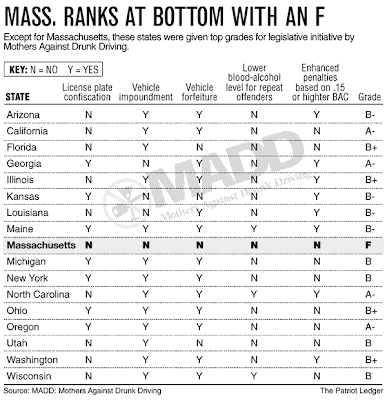
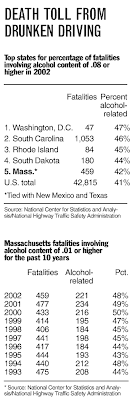
I found a series of articles regarding DWI, Melanie's Law and the laws in Massachusetts that was run in the Patriot Ledger over the last few years. I have put a link in the links section at left to a page of this series that covers how Mass. is lagging behind other states in their DWI laws and convictions. As you read through these quotes and graphics I hope you will follow the links to read through this whole series. Only by making others aware of the lax laws in Massachusetts can we make a change. How can a state that is as pro-active as Massachusetts have such archaic laws as they apply to drunk or drugged driving and repeat offenders who obviously have no respect for the law and will not be rehabilitated. We allow Gay marriage (the only state to do so) and fight for the rights of illegal immigrants (they are here illegally), but will not keep people who abuse the law repeatedly off the streets - something just isn't right here!

Here are a few quotes from this series:

* Massachusetts is the worst in the nation at finding out who’s been drinking, driving and causing deadly crashes. - http://www.southofboston.net/specialreports/drunkendriving/111806a.shtml

* Surviving drivers were tested in only five of 296 fatal crashes in Massachusetts last year. That's 1.7 percent, lowest in the country. According to the National Highway Traffic Safety Administration, the national average was 31 percent.

The federal agency has pushed for years to test all drivers involved in deadly accidents. But nine states, including Massachusetts, still do not require or even recommend blood-alcohol testing of surviving drivers in fatal crashes.

Massachusetts tests nine out of 10 victims of fatal crashes as part of routine autopsies. -
http://www.southofboston.net/specialreports/drunkendriving/111806a.shtml

* Flunking the test: Mass. policy is nation's most lax
Massachusetts has no law requiring alcohol testing, but five other states do.Drivers involved in fatal accidents in New Hampshire have no right to refuse blood-alcohol tests if they’re suspected of causing the crash.

“The officer can actually, if need be, restrain the person physically while the blood is being withdrawn,” said Earl Sweeney, assistant commissioner of public safety in New Hampshire.

Maine has the same policy, but it applies to all fatal accidents regardless of who’s at fault.


“We test anybody in a serious accident where death occurs or is likely to occur,” said Kennebec County District Attorney Evert Fowle, head of the Maine Prosecutors Association. “It’s certainly called for by the law, and we do it.”

Maine tests 77 percent of drivers involved in fatal crashes, second only to South Carolina’s 94 percent. New Hampshire tested 32 percent, slightly above the national average.

But in Massachusetts, police can ask drivers to take a test only after they’ve been arrested for drunk driving. Here, the number tested is less than 2 percent. No other state tests so few drivers.
- http://www.southofboston.net/specialreports/drunkendriving/111806a.shtml

* Good lawyers, soft judges: Drunks still drive - No jail time for 85% of those convicted
...and more than two dozen other South Shore drivers who are currently facing their third, fourth, fifth, even eighth drunken driving offenses.

Why are they still on the road?

Prosecutors, police and anti-drunken driving advocates say the answer lies in a 10,000-word state law that treats drunken driving as a petty crime, gives judges wide latitude in sentencing and allows even chronic drunken drivers to claim hardship to get their licenses back. An overloaded court system, cutbacks in alcohol treatment and a Legislature reluctant to adopt tougher sentencing mandates also contribute to the problem, they say.

All of this has combined to give Massachusetts one of the nation's worst track records for dealing with drunken drivers, both first-time and habitual offenders.
Consider the statistics:
  • Federal highway safety reports show that only four states have a greater percentage of alcohol-related fatalities than Massachusetts.
  • While the percentage of fatalities caused by drunken driving has declined nationally during the past 20 years, Massachusetts' has declined at a lower rate than the national average, and only marginally since 1993.
  • Massachusetts received a D-minus last year from Mothers Against Drunk Driving. The only lower grade was Montana's F.
  • Faced with the loss of federal highway money, Massachusetts this year became the last state in the nation to adopt the so-called "per se" law, which defines a blood-alcohol level of .08 as irrefutable proof in court that a person is legally drunk.

- http://www.southofboston.net/specialreports/drunkendriving/1a.shtml

* Federal studies estimate that drunken driving costs the United States $114 billion a year in medical expenses, lost wages and decreased quality of life. Massachusetts' share of that bill is $1.8 billion.

The statistics obscure a compound tragedy experienced by many victims and families: often the auto insurance carried by the drunken driver, or by the victims, is totally inadequate to cover the costs.

Repeat offenders who have lost their license may have no insurance at all, forcing victims to rely only on their own. In any case, victims sometimes face years of litigation to recoup some of their costs.
- http://www.southofboston.net/specialreports/drunkendriving/2a.shtml


Graphics from "Driving to Endanger" - Patriot Ledger Series


Wednesday, March 21, 2007

Melanie's Law - Massachusetts OUI Law Changes

The following is from a website that is set up by a law firm that defends DWI/DUI/OUI Drivers, http://www.madrunkdrivingdefense.com/melanieslaw.htm - Sue

Melanie's Law - Massachusetts OUI Law Changes
Massachusetts Passed "Melanie's Law" on October 28, 2005


Some of the new changes to Massachusetts Drunk Driving / OUI laws are as follows...

For First Offenders (1st Offense) Massachusetts DUI/OUI:

If You Refused the Breath Test:
- No 15 day temporary license
- May impound your car for 12 hours
- License Suspension consecutive with any OUI conviction penalty
- Under 21 Breath Test refusal 1st OUI offense - 3 year license suspension
- The Breath Test refusal penalty is a 180 day license suspension (no change with Melanie's Law, other than the consecutive license suspension)

If you are Found Guilty:
- Under 21 with BAC of over .20 must attend a 14-day second offender in-home program

For Second Offenders (2nd Offense) Massachusetts DUI/OUI:

If You Refused the Breath Test:
- 3 Year License Suspension, consecutive with any OUI conviction penalty
- Under 21 Breath Test refusal 2nd OUI offense - 5 year license suspension

If you are Found Guilty:
- Not eligible for work/school hardship license for 1 year (+3 additional years of if you refused the breath test)
- As of 1/1/06, Ignition Interlock device installed in your car at your own expense for 2 years as a condition of license reinstatement.

For Third Offense (3rd Offense) OUI Massachusetts OUI / Drunk Driving

If You Refused the Breath Test:
- Under 21 Breath Test refusal 3rd OUI offense - Lifetime license suspension

If you are Found Guilty:
- They can seize, keep, and sell your vehicle for a third or subsequent OUI offense..
- Not eligible for work/school hardship license for 2 year (+5 additional years of if you refused the breath test)
- The Registry may cancel your registration while your license is suspended for a third or subsequent OUI offense.

New OUI Related Laws
  • If you live outside of Massachusetts, you may take an eligible treatment program in your state as part of your penalty.
  • Committing OUI-related offenses while having a license suspended or revoked for OUI-related reasons (OUI, vehicular homicide, OUI with serious injury, OUI or homicide in a boat, or vehicular manslaughter) Penalty for conviction - mandatory minimum sentence of 1 year, to be served consecutively to any other sentence.
  • Your vehicle may be forfeited for a 4th (fourth) offense OUI or subsequent offense.
  • Child Endangerment by Operating Under the Influence - If you are convicted of an OUI while a child under 14 is in the car, their is an additional penalty of a license loss of 1 year (consecutive with any other license loss period). Mandatory 6 months in jail for a 2nd offense, and a 3 year license loss (consecutive)


Other Related New Laws

  • Knowingly hiring an unlicensed person to operate a motor vehicle - Penalty for conviction, license suspension for 1 year
  • Knowingly providing a motor vehicle to an unlicensed person - Penalty for conviction, license suspension for 1 year
  • Lifetime license revocation for vehicular homicide involving OUI, felony vehicular homicide after a prior OUI offense, or OUI with serious injury, or vehicular manslaughter.
  • Increase mandatory minimum sentence for manslaughter by motor vehicle to 5 years in jail.
  • First Offense Vehicular Homicide license suspension increases from 10 to 15 years.

Tuesday, March 20, 2007

Massachusetts Homicide and Vehicular Homicide Laws

Sorry for the delay in posting...I tripped a couple of days ago and broke a couple of bones in my right hand (sigh) so typing is going a bit slow. The knuckles where my little finger and my ring finger attach to my hand are a bit "mashed". I guess my brother and I have the same Klutz gene...he broke fingers and knuckles on the same hand about 4 weeks ago.

I've received some more response to my letters and phone calls regarding strengthening the repeat offender DWI/DUI/OUI laws (they all have the same meaning according to Mass. law). In addition to hearing back from MA Rep. Jeffrey Perry and MA State Senator Mark Montigney I have also received a letter from Vice President Cheney and the MA State Attorney General. Today I have a message on my answering machine to return a call from Sen. John Kerry's office.
The following information is from the Norfolk County Massachusetts District Attorney's website

A Brief Overview of Massachusetts Homicide Law
Massachusetts law defines a homicide as the willful (non-negligent) killing of one human being by another. There are two categories of criminal homicide under Massachusetts law-murder and manslaughter. There are also different classifications of murder and manslaughter. Which homicide crime has been committed (and the punishment that can or must be imposed) generally depends on the manner in which the crime was committed and the intent on the part of the perpetrator.

Classifications of Murder / Punishment
First Degree Murder / Life, without possibility of parole
Second Degree Murder / Life, parole elegibility after 15 years

Classifications of Manslaughter / Punishment
Voluntary Manslaughter / State prison up to 20 years; plus fines
Involuntary Manslaughter / State prison up to 20 years; plus fines
Vehicular Homicide / State prison up to 20 years; plus fines

A Brief Overview of Massachusetts Vehicular Homicide Law
(Melanie's Law increased the mandatory minimum, more info in next post-Sue)

Vehicular Homicide While Operating Under the Influence of Alcohol or Other Drugs and While Operating To Endanger = Mandatory minimum 2 ½ years and up to 15 years in state prison or mandatory minimum 1 year and up to 2 ½ years in jail; plus fines*

Vehicular Homicide While Operating Under the Influence of Alcohol or Other Drugs or While Operating To Endanger = Mandatory minimum 30 days and up to 2 1/2 years in jail; plus fines*
*Also loss of license

Massachusetts Vehicular Homicide Statistics (1998):
1998 alcohol-related statistics for Massachusetts


All traffic fatalities/Alcohol-related fatalities/% Alcohol-related
406 / 192 / 47.4*%
Statistics from National Highway Traffic Safety Administration (NHTSA)


National Vehicular Homicide Trends - According to the National Highway Transportation Safety Administration (NHTSA):
* More than 35% of all 16-to-20 year-old deaths result from motor vehicle crashes.
* 37% of these motor vehicle fatalaties were alcohol-related crashes.
* The troubling news: During a typical weekend, an average of one teenager dies each hour in a car crash. Car crashes are the #1 cause of death among teens.
* Promising news: Since 1989, less than half of youth motor vehicle fatalities have been alcohol-related.

Sue

Friday, March 16, 2007

www.JusticeForDiane.com

To make it easier to find this site, and since I have found that Google is now listing us in the blog search and not their regular internet search, I have set up www.JusticeForDiane.com which will bring you right to this site. If you have already bookmarked this site or saved it to your favorites, do not worry, you will still be brought right to the home page as usual.

Sue