In order to be able to get an idea of what people are thinking in regards to various Massachusetts laws relating to repeat offenders, operating under the influence of drugs or alcohol, vehicular homicide, and concurrent sentencing I will be putting a few polls up, located just under Diane's picture at left.
Polls will generally last for 30 days or longer.
All votes are anonymous and while you can only vote once, you can go back and change that vote.
Please take the time to vote.
Within the week I will be putting up a link to an online petition too. Be sure to check back as we start phase two of this site. Now that Parker has been sentenced and sent to jail (too briefly in my opinion) I will Begin to work in earnest to bring our motor vehicle laws in line with most other states. At this time Massachusetts is losing out on Federal funding because the driving laws are not in line with federal guidelines - Lets do something to fix that!
Showing posts with label Driving While Impaired. Show all posts
Showing posts with label Driving While Impaired. Show all posts
Saturday, July 28, 2007


Convicted driver pleads guilty to fifth DUI - Cape Cod Times
The following article is in today's issue of Cape Cod Times, as well as on their website. I promise that I will write up exactly what happened at both dispositions, I've just been unbelievably busy the last couple of days.
By Aaron Gouvea Cape Cod Times
July 28, 2007
FALMOUTH — Different court room, same result.
Christopher Parker, 50, pleaded guilty in Falmouth District Court yesterday to operating a motor vehicle under the influence of drugs and received a 2 ½-year sentence, six months above the minimum mandatory sentence for a fifth offense. In addition, he also received a one-year sentence for operating a motor vehicle negligently for the incident last October while driving in Bourne.
The sentences will run concurrently with the 2 ½-year sentence Parker received on Wednesday in Barnstable Superior Court, where he pled guilty to vehicular homicide.
Parker, of Forestdale, killed Diane Carhart, 63, in March when he slammed his Honda Accord into her Chevy Tracker on Route 130 in Sandwich. Police said Parker looked down to adjust a portable radio, causing the crash.
Although the last six months of his sentence will be suspended, he will be on probation for a combined four years. Parker will also have to submit to random drug and alcohol testing both in and out of prison, as well as alcohol counseling.
Carhart's daughter, Susan Linhares of Mattapoisett, is hopeful the punishments will serve as a fresh start for Parker and his family.
"I really do wish the man could clean himself up for his family's sake," Linhares said yesterday after Parker's court appearance. "My mother and I have never been vindictive people and while we won't forgive, we don't wish anybody harm."
By Aaron Gouvea Cape Cod Times
July 28, 2007
FALMOUTH — Different court room, same result.
Christopher Parker, 50, pleaded guilty in Falmouth District Court yesterday to operating a motor vehicle under the influence of drugs and received a 2 ½-year sentence, six months above the minimum mandatory sentence for a fifth offense. In addition, he also received a one-year sentence for operating a motor vehicle negligently for the incident last October while driving in Bourne.
The sentences will run concurrently with the 2 ½-year sentence Parker received on Wednesday in Barnstable Superior Court, where he pled guilty to vehicular homicide.
Parker, of Forestdale, killed Diane Carhart, 63, in March when he slammed his Honda Accord into her Chevy Tracker on Route 130 in Sandwich. Police said Parker looked down to adjust a portable radio, causing the crash.
Although the last six months of his sentence will be suspended, he will be on probation for a combined four years. Parker will also have to submit to random drug and alcohol testing both in and out of prison, as well as alcohol counseling.
Carhart's daughter, Susan Linhares of Mattapoisett, is hopeful the punishments will serve as a fresh start for Parker and his family.
"I really do wish the man could clean himself up for his family's sake," Linhares said yesterday after Parker's court appearance. "My mother and I have never been vindictive people and while we won't forgive, we don't wish anybody harm."
Friday, July 27, 2007
Disposition on October DUI charge against Parker
I'm leaving now to go to the Falmouth District Court in Falmouth, MA in order to see what Parker receives for a sentence. I've been told there is a chance that any jail time in this charge could be served concurrently to his jail time he is serving in Diane's case. I really hope that is not the case since this case happened 5 months before the crash that Parker has been found guilty of where Diane died, it was in a different location, with the cases in two different courthouses. I just don't see how they could do that.
I'll be back around 11am as far as I know and will post the results of the case when I get back home so stop back by in a few hours.
I'll be back around 11am as far as I know and will post the results of the case when I get back home so stop back by in a few hours.
Wednesday, July 25, 2007
Is Today the Day???
I feel almost like a little kid waiting for Santa on Christmas Eve or trying to sleep the day before a birthday, the anticipation that I have had for today to come has been great.
Could today be the day that Parker accepts guilt for killing my Mom, Diane? Will I finally be able to read the impact statements that my brother and I have written? Will Francine Abbott be there with a victim impact statement? How will Parker act while we are reading the statements? Will he show any remorse at all or just stare ahead blankly like he has done in his other court appearences? Will the Judge sentence him to the full sentence? Basically, what will happen?
I've had my clothes picked out and ironed for days, wanting to look respectable in front of the Judge. I have been surprized at what some of the people who appear before the Judges (either defendant or plaintiff) wear, anything from dirty jeans and stained, ripped tee-shirts to short mini skirts with half tank tops.
Well I guess I'll go shower and get ready. I want to leave an extra hour early incase of Cape Cod traffic or road work.
Could today be the day that Parker accepts guilt for killing my Mom, Diane? Will I finally be able to read the impact statements that my brother and I have written? Will Francine Abbott be there with a victim impact statement? How will Parker act while we are reading the statements? Will he show any remorse at all or just stare ahead blankly like he has done in his other court appearences? Will the Judge sentence him to the full sentence? Basically, what will happen?
I've had my clothes picked out and ironed for days, wanting to look respectable in front of the Judge. I have been surprized at what some of the people who appear before the Judges (either defendant or plaintiff) wear, anything from dirty jeans and stained, ripped tee-shirts to short mini skirts with half tank tops.
Well I guess I'll go shower and get ready. I want to leave an extra hour early incase of Cape Cod traffic or road work.
Wednesday, July 18, 2007
Parker's October DUI Charges Postponed Again
On Wednesday, July 18 at 9:00am I was once again at the Falmouth District Courthouse in Falmouth, MA in order to hear what would transpire with the DUI charges that Christopher G. Parker is facing when he was arrested last October in Bourne.
A different Judge was now presiding on the case due to the health of the original Judge. Judge Nagler is now assigned to the case. When "Commonwealth vs. Christopher G. Parker" was called A.D.A. Ilene Connors as well as Parker's Attorney Arnold Lett requested a side bar with the judge. The three of them spoke for several minutes and then a Disposition date of July 27, 2007 at 9:00am was announced. It is hoped that Parker will either plead or be found guilty of the DUI charge on that date.
A different Judge was now presiding on the case due to the health of the original Judge. Judge Nagler is now assigned to the case. When "Commonwealth vs. Christopher G. Parker" was called A.D.A. Ilene Connors as well as Parker's Attorney Arnold Lett requested a side bar with the judge. The three of them spoke for several minutes and then a Disposition date of July 27, 2007 at 9:00am was announced. It is hoped that Parker will either plead or be found guilty of the DUI charge on that date.
Thursday, June 28, 2007
June 28th Pre-Trial Hearing in Falmouth
Today, at the Falmouth District Courthouse, Christopher G. Parker was to appear for a Pre-Trial Hearing. Since he is still in custody at the Barnstable County Correctional Facility I'm not sure if he actually was brought to the Courthouse by the Sheriff as he didn't appear in the courtroom.
I met up with George Brennan from the Cape Cod Times after checking in with the Victim/Witness Advocate's office and we proceeded into the first session courtroom. Once again I was surprised at how small the courtrooms in Falmouth are. The first session room was about twice the size of the second session room which I have previously mentioned - still very small, with all seats taken.
We listened to the arraignments and probation matters and eventually Denise from the Victim/Witness office came to let me know that the case has been continued yet again, this time to July 18, 2007 at 9:ooam.
I'm getting the idea that Parker's two attorneys (Arnold Lett for the DWI in Oct. 2006 and Woodrow Brown for the Vehicular Homicide and Driving With a Revoked License in regards to Diane's death) are not too sure which case they would like to go to trial or disposition first. Would it be worse for Parker if he was convicted of his fifth or sixth DWI before going up on the charges resulting from Diane's death or would it be worse if he had a charge of Vehicular Homicide and driving on a revoked license before going up on the DWI?
To me it seems that it wouldn't make much difference, either way these are serious charges. Additionaly it is my hope that the two cases will be tried seperately with the punishments being served consecutively and not concurrantly. I'm getting the feeling that the delay tactics that Parker's Attorneys have been using are because they want the possible sentences in each case to be as lenient as possible and that they be served concurrantly.
While the job of the defense attorney is to make sure that the defendant's rights are upheld it seems that they take that even further in a type of game in which they are the winner if they can get as little as possible or no jail time for their clients. They hit the jackpot if they can get the case dismissed. I have more that I'd like to say but will save it for a later topic. As an eye opener try searching the internet for the terms DWI, DUI, OUI, or drunk driving. You will find a mulitude of defense lawyers and their websites which tell you how they can help you either get the charges dismissed, what to do when you are pulled over and the police suspect that you are under the influence of alchohol or drugs, and in the event that you are found guilty they state that they will get you the least possible sentence. In my personal opinion these lawyers are as much to blame as the defendants themselves for the repeat offenders that are epidemic on our roadways.
I met up with George Brennan from the Cape Cod Times after checking in with the Victim/Witness Advocate's office and we proceeded into the first session courtroom. Once again I was surprised at how small the courtrooms in Falmouth are. The first session room was about twice the size of the second session room which I have previously mentioned - still very small, with all seats taken.
We listened to the arraignments and probation matters and eventually Denise from the Victim/Witness office came to let me know that the case has been continued yet again, this time to July 18, 2007 at 9:ooam.
I'm getting the idea that Parker's two attorneys (Arnold Lett for the DWI in Oct. 2006 and Woodrow Brown for the Vehicular Homicide and Driving With a Revoked License in regards to Diane's death) are not too sure which case they would like to go to trial or disposition first. Would it be worse for Parker if he was convicted of his fifth or sixth DWI before going up on the charges resulting from Diane's death or would it be worse if he had a charge of Vehicular Homicide and driving on a revoked license before going up on the DWI?
To me it seems that it wouldn't make much difference, either way these are serious charges. Additionaly it is my hope that the two cases will be tried seperately with the punishments being served consecutively and not concurrantly. I'm getting the feeling that the delay tactics that Parker's Attorneys have been using are because they want the possible sentences in each case to be as lenient as possible and that they be served concurrantly.
While the job of the defense attorney is to make sure that the defendant's rights are upheld it seems that they take that even further in a type of game in which they are the winner if they can get as little as possible or no jail time for their clients. They hit the jackpot if they can get the case dismissed. I have more that I'd like to say but will save it for a later topic. As an eye opener try searching the internet for the terms DWI, DUI, OUI, or drunk driving. You will find a mulitude of defense lawyers and their websites which tell you how they can help you either get the charges dismissed, what to do when you are pulled over and the police suspect that you are under the influence of alchohol or drugs, and in the event that you are found guilty they state that they will get you the least possible sentence. In my personal opinion these lawyers are as much to blame as the defendants themselves for the repeat offenders that are epidemic on our roadways.
Thursday, June 21, 2007
No Guilty Plea today :-(
Well there you have it, Parker didn't take responsibility for his actions and plead guilty to charges of vehicular homicide and driving on a revoked license.
Since it was Thursday, a day when the weekend travel to the Cape begins I left early, giving myself two hours to make the normally forty-five minutes drive from Mattapoisett to Barnstable. I brought a book along with me because I thought I'd be getting there early...I was wrong. It started off with thick extremely slow traffic on Route 25 due to an accident just before the Bourne Bridge. I was finally able to slip around the traffic and take the exit where I could get to the Sagamore Bridge and onto Cape Cod. Everything was going smoothly up until I had just passed exit 4. Then the two lanes of traffic all but stopped. I had used up a good deal of my time already back in the traffic at the Bourne Bridge . I normally take exit 6 on the Mid-Cape Highway and now I had to inch along for a few miles until I could get off at exit 5 to try to get around the gridlock. As I took the exit and turned left I was hoping that this road would connect with route 6A, which I could then take into Barnstable. After about a mile I said "Hooray!" for right in front of me was the intersection with 6A. It was 2:00 by now, when I was due at the courthouse. Of course my "Murphy's Law" luck continued when an elderly woman pulled out in front of me and proceeded down the road at 20 MPH, braking at even the slightest curve in the road and every time a car passed going the other direction.
Finally I made it to the Barnstable District Courthouse and hurried in. I was fifteen minutes late and I was afraid that I might miss it. Thankfully they hadn't started yet and I met George Brennan and the Sandwich Police Chief right in front of the first session courtroom doors. Shortly after that Kathleen Finnegan our Victim/Witness advocate and A.D.A. Brian Shea walked up. I talked with Kathleen and Brian briefly and then we entered the courtroom. Being told I can sit anywhere that I would be comfortable I chose the front row. Kathleen came to sit with me and I showed her the Victim Impact Statements that Johnny and I had written. As she was reading the Judge came in and they brought the prisoners in. She handed the papers to me so that we could listen to what was going to happen. The clerk called "Commonwealth vs. Christopher G. Parker" and Parker stood up. He was wearing prison issue blue pants and blue shirt. His hands were cuffed in front of him. His hair had grown back a small amount and was in a crew cut style.
Unfortunately Parker did not plead guilty and so they scheduled the date of July 10, 2007 at 2:oopm for his next appearance in court. While I was a little disappointed I did realize that there was the chance for at least one continuance. Hey, at least we had our Victim Impact Statements done. Thinking about what I've learned about Christopher G. Parker it doesn't surprise me that he would not accept his guilt. I'm trying to be informative here and not voice a personal vendetta so I won't elaborate on that thought.
On the way out of the courthouse I noticed a woman with her right leg in a cast and walking with a cane. Since I had been informed that Francine Abbott, the driver of the NStar truck, also wanted to give an impact statement, and knowing that she had suffered some sort of injury to at least one of her legs during the crash I took a chance and approached her as she sat outside in the sun after the hearing. I asked if she was Francine Abbott and she said yes. I introduced myself and we hugged. She told me that her right ankle was "blown out", severly broken, during the crash and she has had a couple of surgeries on it already. After a few moments talking with her I left to walk to my car, being glad that I'd had the chance to meet Francine. I know my mother would have like that.
So another court date is done and next up is Parker appearing in Falmouth District Court on the October DWI charges Thursday June 28, 2007 at 9am. I'll be there and will have an update as to what happens there. I'm sure it is too much to hope for that Parker would plead guilty to that charge either, but I guess I can always hope......
Since it was Thursday, a day when the weekend travel to the Cape begins I left early, giving myself two hours to make the normally forty-five minutes drive from Mattapoisett to Barnstable. I brought a book along with me because I thought I'd be getting there early...I was wrong. It started off with thick extremely slow traffic on Route 25 due to an accident just before the Bourne Bridge. I was finally able to slip around the traffic and take the exit where I could get to the Sagamore Bridge and onto Cape Cod. Everything was going smoothly up until I had just passed exit 4. Then the two lanes of traffic all but stopped. I had used up a good deal of my time already back in the traffic at the Bourne Bridge . I normally take exit 6 on the Mid-Cape Highway and now I had to inch along for a few miles until I could get off at exit 5 to try to get around the gridlock. As I took the exit and turned left I was hoping that this road would connect with route 6A, which I could then take into Barnstable. After about a mile I said "Hooray!" for right in front of me was the intersection with 6A. It was 2:00 by now, when I was due at the courthouse. Of course my "Murphy's Law" luck continued when an elderly woman pulled out in front of me and proceeded down the road at 20 MPH, braking at even the slightest curve in the road and every time a car passed going the other direction.
Finally I made it to the Barnstable District Courthouse and hurried in. I was fifteen minutes late and I was afraid that I might miss it. Thankfully they hadn't started yet and I met George Brennan and the Sandwich Police Chief right in front of the first session courtroom doors. Shortly after that Kathleen Finnegan our Victim/Witness advocate and A.D.A. Brian Shea walked up. I talked with Kathleen and Brian briefly and then we entered the courtroom. Being told I can sit anywhere that I would be comfortable I chose the front row. Kathleen came to sit with me and I showed her the Victim Impact Statements that Johnny and I had written. As she was reading the Judge came in and they brought the prisoners in. She handed the papers to me so that we could listen to what was going to happen. The clerk called "Commonwealth vs. Christopher G. Parker" and Parker stood up. He was wearing prison issue blue pants and blue shirt. His hands were cuffed in front of him. His hair had grown back a small amount and was in a crew cut style.
Unfortunately Parker did not plead guilty and so they scheduled the date of July 10, 2007 at 2:oopm for his next appearance in court. While I was a little disappointed I did realize that there was the chance for at least one continuance. Hey, at least we had our Victim Impact Statements done. Thinking about what I've learned about Christopher G. Parker it doesn't surprise me that he would not accept his guilt. I'm trying to be informative here and not voice a personal vendetta so I won't elaborate on that thought.
On the way out of the courthouse I noticed a woman with her right leg in a cast and walking with a cane. Since I had been informed that Francine Abbott, the driver of the NStar truck, also wanted to give an impact statement, and knowing that she had suffered some sort of injury to at least one of her legs during the crash I took a chance and approached her as she sat outside in the sun after the hearing. I asked if she was Francine Abbott and she said yes. I introduced myself and we hugged. She told me that her right ankle was "blown out", severly broken, during the crash and she has had a couple of surgeries on it already. After a few moments talking with her I left to walk to my car, being glad that I'd had the chance to meet Francine. I know my mother would have like that.
So another court date is done and next up is Parker appearing in Falmouth District Court on the October DWI charges Thursday June 28, 2007 at 9am. I'll be there and will have an update as to what happens there. I'm sure it is too much to hope for that Parker would plead guilty to that charge either, but I guess I can always hope......
Thursday, May 10, 2007
Cape Cod man faces vehicular homicide charges - Boston Herald Article
Well it seems that Parker's $10,000 cash bail/$100,000 surety has been noticed by the Associated Press, and because of that Parker's arraignment yesterday is receiving new media attention. So far in a brief search I've found mention in the Cape Cod Times, the Boston Herald, and on WLNE channel 6's website. I'll continue to post the articles as I find more. Some of the stories are similar with only minor changes since the media uses the articles from the AP.
Updated: 06:27 AM EST
BARNSTABLE - A Cape Cod man who has been convicted of impaired driving four times pleaded not guilty to vehicular homicide on Wednesday.
Christopher Parker, 50, faces the charge in connection with a three-vehicle crash in March that resulted in the death of a Sandwich woman.
Parker was taken into custody on the homicide charge after a Falmouth District Court judge revoked his bail in an unrelated case in which he is charged with driving under the influence of drugs.
Parker pleaded not guilty at his arraignment in Barnstable District Court on Wednesday and was ordered held on $10,000 cash bail. He was also charged with driving with a revoked license.
Diane Carhart, 63, was killed March 5 when her vehicle was struck from behind on Route 130 by Parker’s car and pushed into the path of an oncoming NStar [NST] pickup truck, according to police. Parker suffered minor injuries.
"It’s been really hard leading up to Mother’s Day," Carhart’s daughter, Susan Linhares, told The Cape Cod Times. "Everywhere you turn, there are reminders and it’s very difficult."
Parker’s driving record includes four operating under the influence convictions.
© Copyright 2007 Associated Press. All rights reserved.
Cape Cod man faces vehicular homicide charges
By Associated Press Thursday, May 10, 2007
Updated: 06:27 AM EST
BARNSTABLE - A Cape Cod man who has been convicted of impaired driving four times pleaded not guilty to vehicular homicide on Wednesday.
Christopher Parker, 50, faces the charge in connection with a three-vehicle crash in March that resulted in the death of a Sandwich woman.
Parker was taken into custody on the homicide charge after a Falmouth District Court judge revoked his bail in an unrelated case in which he is charged with driving under the influence of drugs.
Parker pleaded not guilty at his arraignment in Barnstable District Court on Wednesday and was ordered held on $10,000 cash bail. He was also charged with driving with a revoked license.
Diane Carhart, 63, was killed March 5 when her vehicle was struck from behind on Route 130 by Parker’s car and pushed into the path of an oncoming NStar [NST] pickup truck, according to police. Parker suffered minor injuries.
"It’s been really hard leading up to Mother’s Day," Carhart’s daughter, Susan Linhares, told The Cape Cod Times. "Everywhere you turn, there are reminders and it’s very difficult."
Parker’s driving record includes four operating under the influence convictions.
© Copyright 2007 Associated Press. All rights reserved.
Wednesday, May 2, 2007
Are felony DWI offenders getting away with murder?
The article below is from Houston, TX, KHOU channel 11's website. The story sounds all to familiar, and is actually what my family and I have been saying from the moment that we learned about Christopher Parker's extensive DWI/OUI arrest record. I've also mentioned that it seemed as if Parker knew how to work the system. It seems that each and every day repeat offenders are picked up for driving while intoxicated. Unfortunately those offenders do not go to jail each and everyday, but are allowed out on bail or probation...with promises of doing a couple of hours of community service. While this story below is based in Texas I thought it was very appropriate for our site.
Are felony DWI offenders getting away with murder?
11:57 AM CDT on Sunday, April 29, 2007
By Dave Fehling / 11 News
In the past two years, police in Harris County charged over 1,900 drivers with felony DWI, but some say chronic offenders have learned to work the system and never pay the price.
For example, an allegedly very drunk driver was accused last month of killing a mother and daughter in a horrific smash-up on the Eastex Freeway.
Police said he’d already had three previous DWI convictions.
“They’re not following through on penalties,” said Ruth Tijerina, who lost her daughter in a drunk driving crash in 2004.
Texas has the three strikes DWI law: The third arrest means a felony charge. Felony as in prison, loss of voting rights and public humiliation.
But when 11 News asked the county to provide us with records showing what really happens, what we discovered was disturbing.
In the past two years in Harris County alone, 492 of the more than 1,900 felony DWI cases were reduced to misdeameanor charges.
“At some point, they need to be locked away,” said John Bradley, the Williamson County D.A. known for its tough stance on DWI.
So why aren’t they?
“Your chronic DWI offender, the person who has two or more prior arrests for DWI, has completely learned how to work the system,” said Bradley.
Are felony DWI offenders getting away with murder?
11:57 AM CDT on Sunday, April 29, 2007
By Dave Fehling / 11 News
In the past two years, police in Harris County charged over 1,900 drivers with felony DWI, but some say chronic offenders have learned to work the system and never pay the price.
For example, an allegedly very drunk driver was accused last month of killing a mother and daughter in a horrific smash-up on the Eastex Freeway.
Police said he’d already had three previous DWI convictions.
“They’re not following through on penalties,” said Ruth Tijerina, who lost her daughter in a drunk driving crash in 2004.
Texas has the three strikes DWI law: The third arrest means a felony charge. Felony as in prison, loss of voting rights and public humiliation.
But when 11 News asked the county to provide us with records showing what really happens, what we discovered was disturbing.
In the past two years in Harris County alone, 492 of the more than 1,900 felony DWI cases were reduced to misdeameanor charges.
“At some point, they need to be locked away,” said John Bradley, the Williamson County D.A. known for its tough stance on DWI.
So why aren’t they?
“Your chronic DWI offender, the person who has two or more prior arrests for DWI, has completely learned how to work the system,” said Bradley.
Wednesday, April 4, 2007
Magistrate Hearing Today!
Well it has taken one day shy of a month to get Christopher G. Parker into court in regards to my mother's death, but today is the day!
Parker has requested a magistrate hearing and it will be held at 2pm in the Barnstable District Courthouse, 3231 Main St Barnstable, MA. Anyone who would like to join us at the courthouse today is welcome. Directions can be found HERE.
I am hoping that he will not have the charges dismissed, but that is a possiblility. Not that there isn't sufficient evidence, but that the magistrate can do whatever he/she wants. The Assistant District Attorney told me that they can never be 100% positive that a case will not be dismissed. I am also hoping that Parker will have his prior bail (from the Oct 2006 charges) revoked and be finally put behind bars...something that should have happened at the scene of the crash or at the hospital as far as I'm concerned.
Check back later today for an update.
Parker has requested a magistrate hearing and it will be held at 2pm in the Barnstable District Courthouse, 3231 Main St Barnstable, MA. Anyone who would like to join us at the courthouse today is welcome. Directions can be found HERE.
I am hoping that he will not have the charges dismissed, but that is a possiblility. Not that there isn't sufficient evidence, but that the magistrate can do whatever he/she wants. The Assistant District Attorney told me that they can never be 100% positive that a case will not be dismissed. I am also hoping that Parker will have his prior bail (from the Oct 2006 charges) revoked and be finally put behind bars...something that should have happened at the scene of the crash or at the hospital as far as I'm concerned.
Check back later today for an update.
Thursday, March 29, 2007
Glossary of Legal Terms
Glossary of Legal Terms For Massachusetts
Accessory:A person who assists another in the commission of a crime, either before or after the fact.
Adjudication: A declaration by a judge.
Administrator: A person appointed by the court to settle the estate of a dead person when there is no will, or when there is a will but the executor has died, resigned or been removed from office.
Affidavit: A written or printed statement under oath.
Affidavit: A written or printed statement under oath.
Affirmative defense: A defense in which the accused is required to produce the supporting evidence.
Amicus curiae: A “friend of the court”; usually an interested person or agency, not a party to an ongoing case, that wishes to make its position known. This is most often done in writing.
Amortization: The payment of a debt by installments.
Answer: A document filed in response to a complaint.
Appearance: The procedure by which an attorney acknowledges his representation of a party in a suit; also the submission of the defendant to the jurisdiction of the court.
Appellant: The party appealing a decision to a higher court.
Appellate court: The court having jurisdiction of appeal and review of law; not a trial court.
Appellee: The party against whom an appeal is taken.
Arraignment: The reading of a charge and the entering of a plea in response.
Amicus curiae: A “friend of the court”; usually an interested person or agency, not a party to an ongoing case, that wishes to make its position known. This is most often done in writing.
Amortization: The payment of a debt by installments.
Answer: A document filed in response to a complaint.
Appearance: The procedure by which an attorney acknowledges his representation of a party in a suit; also the submission of the defendant to the jurisdiction of the court.
Appellant: The party appealing a decision to a higher court.
Appellate court: The court having jurisdiction of appeal and review of law; not a trial court.
Appellee: The party against whom an appeal is taken.
Arraignment: The reading of a charge and the entering of a plea in response.
Assignment for the benefit of creditors: The turning over of the assets of a debtor to a creditor or trustee to help pay off his debts.
Attachment: A lien on a defendant’s property to satisfy a legal claim that the plaintiff hopes to prove.
Bail: An amount of money or security posted by a person against whom criminal charges are pending, to guarantee his appearance in court. The bail is determined by considerations such as the nature and circumstance of the charges, whether the person charged is a flight risk, and the
likelihood of their appearance. It is not a reflection of guilt or innocence.
Bail hearing: An appeal to a superior court judge for the reduction of bail set by a judge in a lower court.
Bankruptcy: A method of declaring insolvency when the debtor’s liabilities exceed his assets. It has the practical effect of wiping out past debts. A Chapter 11 bankruptcy permits the continued operation of a business, with the proceeds to go to a trustee for the creditors.
Battery: An un-consented touching.
Attachment: A lien on a defendant’s property to satisfy a legal claim that the plaintiff hopes to prove.
Bail: An amount of money or security posted by a person against whom criminal charges are pending, to guarantee his appearance in court. The bail is determined by considerations such as the nature and circumstance of the charges, whether the person charged is a flight risk, and the
likelihood of their appearance. It is not a reflection of guilt or innocence.
Bail hearing: An appeal to a superior court judge for the reduction of bail set by a judge in a lower court.
Bankruptcy: A method of declaring insolvency when the debtor’s liabilities exceed his assets. It has the practical effect of wiping out past debts. A Chapter 11 bankruptcy permits the continued operation of a business, with the proceeds to go to a trustee for the creditors.
Battery: An un-consented touching.
Bench warrant: A warrant issued “from the bench” for the arrest of a person. It is frequently imposed when a witness or litigant fails to show up for an appearance.
Bill of particulars: A written statement by a prosecutor specifying the details, such as
time, place, manner and means of a crime he expects to prove against the defendant.
Brief: A written or printed argument prepared by counsel to support his case, usually
containing a statement of facts and a discussion of law.
Burden of proof: The duty of affirmatively proving disputed facts in a case.
Cause of action: The right a party has to institute a judicial action: a suit or litigation.
Certiorari: A special type of proceeding in which a court (usually the superior court) is asked by a concerned party to review the proceedings of a state or local administration, agency or board.
Circumstantial evidence: Evidence formed by a non-eyewitness.
Civil action: A non-criminal case.
Codicil: A supplement or addition to a will.
Comparative negligence: A doctrine applicable to those negligence cases in which both the plaintiff and the defendant are found to be negligent. If the “degree” of the plaintiff’s negligence is less than that of the defendant, the plaintiff is still entitled to prevail but any damages allowed
are reduced in proportion to the plaintiff’s negligence. -The legal process by which real estate of a private owner is taken for public use without his consent but upon the award and payment of just compensation.
Consecutive (on and after) sentence: One sentence to be served upon completion
of another sentence, as opposed to concurrent sentences.
Bill of particulars: A written statement by a prosecutor specifying the details, such as
time, place, manner and means of a crime he expects to prove against the defendant.
Brief: A written or printed argument prepared by counsel to support his case, usually
containing a statement of facts and a discussion of law.
Burden of proof: The duty of affirmatively proving disputed facts in a case.
Cause of action: The right a party has to institute a judicial action: a suit or litigation.
Certiorari: A special type of proceeding in which a court (usually the superior court) is asked by a concerned party to review the proceedings of a state or local administration, agency or board.
Circumstantial evidence: Evidence formed by a non-eyewitness.
Civil action: A non-criminal case.
Codicil: A supplement or addition to a will.
Comparative negligence: A doctrine applicable to those negligence cases in which both the plaintiff and the defendant are found to be negligent. If the “degree” of the plaintiff’s negligence is less than that of the defendant, the plaintiff is still entitled to prevail but any damages allowed
are reduced in proportion to the plaintiff’s negligence. -The legal process by which real estate of a private owner is taken for public use without his consent but upon the award and payment of just compensation.
Consecutive (on and after) sentence: One sentence to be served upon completion
of another sentence, as opposed to concurrent sentences.
Consent decree: An agreement of the parties made under the sanction of the court to be bound by certain stipulated facts.
Contempt of court: Any act calculated to embarrass, hinder or obstruct a court in the administration of justice or to lessen its authority or dignity.
Contingent fee: A charge for services, agreed to in advance, based on the lawyer’s successful handling of the case. It is usually a set percentage of the amount won in a lawsuit.
Costs: Actual expenses connected with prosecuting or defending a suit, including filing fees, sheriff’s service, etc., but not including attorney’s fees.
Counterclaim: A claim filed by a defendant against a claimant in the same action.
De novo: Usually applied to trial de novo, a system that permits a defendant to elect a
second, totally new trial before a jury if the first trial was before a judge and the defendant
is dissatisfied with the judge’s decision.
Contempt of court: Any act calculated to embarrass, hinder or obstruct a court in the administration of justice or to lessen its authority or dignity.
Contingent fee: A charge for services, agreed to in advance, based on the lawyer’s successful handling of the case. It is usually a set percentage of the amount won in a lawsuit.
Costs: Actual expenses connected with prosecuting or defending a suit, including filing fees, sheriff’s service, etc., but not including attorney’s fees.
Counterclaim: A claim filed by a defendant against a claimant in the same action.
De novo: Usually applied to trial de novo, a system that permits a defendant to elect a
second, totally new trial before a jury if the first trial was before a judge and the defendant
is dissatisfied with the judge’s decision.
Declaratory judgment: Declares the rights of the parties or the opinion of the court on a question of law.
Decree: Decision or order of the court in certain types of cases; a final decree fully and finally disposes of the litigation; an interlocutory decree is provisional. A final decree has the same effect as a judgment.
Default: In a criminal case, failure to appear upon order of the court. In a civil case, failure to file a pleading or appear within the time allowed.
Deposition: Sworn testimony taken prior to trial out of court and in the presence of a stenographer, usually for the purpose of “discovering” in advance what the witness
is going to say and also to preserve testimony. (See discovery)
Direct evidence: Proof of facts by witnesses who saw and heard what they are testifying
about, as distinguished from circumstantial evidence, which is called indirect evidence.
Directed verdict: An instruction by the trial judge ordering that judgment be entered without the jury considering the matter; used usually when one party has failed to produce enough evidence, considering the merits of the case.
Discovery: The term used to describe various methods for obtaining evidence in advance of trial, including such things as interrogatories, depositions and various motions to permit the inspection of documents, etc.
Dismissal without prejudice: Permits plaintiff to sue again on the same cause of action; dismissal “with prejudice” bars the action forever.
Double jeopardy: A doctrine that prohibits prosecution of a defendant in a criminal matter more than once for the same offense.
Eeminent domain: The power of a government or of certain agencies to take private property for public use, even against the will of the owner, and to pay compensation.
Escrow: The holding by a third person of something of value, e.g., money, deed to property, etc., until some agreed-upon contingency.
Estoppel: A doctrine that prevents any action by a person who has earlier made a
statement or taken a position inconsistent with his present posture. Example: One is estopped from denying a fact he earlier tried to prove.
Ex parte: A proceeding where only one side is heard.
Ex post facto: An act or fact occurring after some previous related act.
Exclusionary rule: A rule prohibiting the use in criminal prosecutions of illegally obtained evidence.
Executor: A person named by the decedent in a will to carry out the will’s provisions.
Extradition: The surrender by one state to another of an individual accused or convicted of an offense in the demanding state’s jurisdiction. In Massachusetts, extradition and rendition are interchangeable.
Felony: Any crime punishable by a year or more in state prison.
Fiduciary: A person who undertakes the duty to act primarily for another’s benefit, usually in financial areas. A fiduciary is bound by a high standard of good faith.
Garnishment: Proceeding whereby property, money or credits of a debtor in the possession of another are applied to the debts of the debtor, as in the garnishment of a person’s wages.
Grand jury: A jury that receives complaints and accusations in criminal cases, hears the evidence and issues indictments in cases where it feels a trial ought to take place. It meets in a secret proceeding not open to the public.
Guardian ad litem: A person appointed by the court to represent the rights of minors, the unborn and others under legal disability.
Habeas corpus: Literally, “you have the body.” An order of the court to bring a person before it; commonly used to test the legality of a prisoner’s detention.
Hearsay: An out-of-court statement offered for the truth of the matter as asserted.
Iimpeachment of witness: Throwing doubt on the credibility of a witness by testimony
showing prior inconsistency, contradiction or a conviction of a crime.
Implied contract: An agreement, not in writing, in which the conduct of the parties indicates their intention to be bound.
In camera: A judge’s chambers; in private.
Indemnify: To compensate another for loss or damage that has already occurred or to give security against future loss.
Indictment: The formal accusation made by a grand jury charging a person (named or unnamed) or corporation with a specific crime.
Interlocutory: Court orders that are provisional, temporary and not final.
Interrogatories: Written questions served on a party which must be answered under oath before trial; one of the methods of discovery.
Intervention: A method by which a person may make himself a party to an action in which he has some special interest.
Intestate: Dying without a will.
Jurisdiction: The authority of a court to hear a particular case and to render a judgment.
Leading question: One that suggests an answer to the witness.
Levy: The seizure of property by legal process.
Lien: A claim upon the property of another on account of a debt.
Lis pendens: Generally a notice filed in the registry of deeds to warn persons that title to certain property is in litigation.
Malfeasance: The performance of an act that a person ought not do. The term is usually applied in connection with public officers.
Mandamus: A court order directing a lower court, agency or official to perform its specific duty.
Manslaughter: Unlawful killing of another without malice during the commission of certain minor crimes or in the heat of passion or through willful, wanton or reckless misconduct. Massachusetts recognizes two kinds: voluntary and involuntary.
Decree: Decision or order of the court in certain types of cases; a final decree fully and finally disposes of the litigation; an interlocutory decree is provisional. A final decree has the same effect as a judgment.
Default: In a criminal case, failure to appear upon order of the court. In a civil case, failure to file a pleading or appear within the time allowed.
Deposition: Sworn testimony taken prior to trial out of court and in the presence of a stenographer, usually for the purpose of “discovering” in advance what the witness
is going to say and also to preserve testimony. (See discovery)
Direct evidence: Proof of facts by witnesses who saw and heard what they are testifying
about, as distinguished from circumstantial evidence, which is called indirect evidence.
Directed verdict: An instruction by the trial judge ordering that judgment be entered without the jury considering the matter; used usually when one party has failed to produce enough evidence, considering the merits of the case.
Discovery: The term used to describe various methods for obtaining evidence in advance of trial, including such things as interrogatories, depositions and various motions to permit the inspection of documents, etc.
Dismissal without prejudice: Permits plaintiff to sue again on the same cause of action; dismissal “with prejudice” bars the action forever.
Double jeopardy: A doctrine that prohibits prosecution of a defendant in a criminal matter more than once for the same offense.
Eeminent domain: The power of a government or of certain agencies to take private property for public use, even against the will of the owner, and to pay compensation.
Escrow: The holding by a third person of something of value, e.g., money, deed to property, etc., until some agreed-upon contingency.
Estoppel: A doctrine that prevents any action by a person who has earlier made a
statement or taken a position inconsistent with his present posture. Example: One is estopped from denying a fact he earlier tried to prove.
Ex parte: A proceeding where only one side is heard.
Ex post facto: An act or fact occurring after some previous related act.
Exclusionary rule: A rule prohibiting the use in criminal prosecutions of illegally obtained evidence.
Executor: A person named by the decedent in a will to carry out the will’s provisions.
Extradition: The surrender by one state to another of an individual accused or convicted of an offense in the demanding state’s jurisdiction. In Massachusetts, extradition and rendition are interchangeable.
Felony: Any crime punishable by a year or more in state prison.
Fiduciary: A person who undertakes the duty to act primarily for another’s benefit, usually in financial areas. A fiduciary is bound by a high standard of good faith.
Garnishment: Proceeding whereby property, money or credits of a debtor in the possession of another are applied to the debts of the debtor, as in the garnishment of a person’s wages.
Grand jury: A jury that receives complaints and accusations in criminal cases, hears the evidence and issues indictments in cases where it feels a trial ought to take place. It meets in a secret proceeding not open to the public.
Guardian ad litem: A person appointed by the court to represent the rights of minors, the unborn and others under legal disability.
Habeas corpus: Literally, “you have the body.” An order of the court to bring a person before it; commonly used to test the legality of a prisoner’s detention.
Hearsay: An out-of-court statement offered for the truth of the matter as asserted.
Iimpeachment of witness: Throwing doubt on the credibility of a witness by testimony
showing prior inconsistency, contradiction or a conviction of a crime.
Implied contract: An agreement, not in writing, in which the conduct of the parties indicates their intention to be bound.
In camera: A judge’s chambers; in private.
Indemnify: To compensate another for loss or damage that has already occurred or to give security against future loss.
Indictment: The formal accusation made by a grand jury charging a person (named or unnamed) or corporation with a specific crime.
Interlocutory: Court orders that are provisional, temporary and not final.
Interrogatories: Written questions served on a party which must be answered under oath before trial; one of the methods of discovery.
Intervention: A method by which a person may make himself a party to an action in which he has some special interest.
Intestate: Dying without a will.
Jurisdiction: The authority of a court to hear a particular case and to render a judgment.
Leading question: One that suggests an answer to the witness.
Levy: The seizure of property by legal process.
Lien: A claim upon the property of another on account of a debt.
Lis pendens: Generally a notice filed in the registry of deeds to warn persons that title to certain property is in litigation.
Malfeasance: The performance of an act that a person ought not do. The term is usually applied in connection with public officers.
Mandamus: A court order directing a lower court, agency or official to perform its specific duty.
Manslaughter: Unlawful killing of another without malice during the commission of certain minor crimes or in the heat of passion or through willful, wanton or reckless misconduct. Massachusetts recognizes two kinds: voluntary and involuntary.
Misdemeanor: A criminal offense less than a felony, generally punishable by fine or imprisonment in a jail or a house of correction rather than a state prison.
Moot: Loosely, an issue that has been settled by some happening other than judicial
determination.
Motion: A request that a court act or rule in a certain way.
Negligence: The omission of an act that a reasonable person, guided by ordinary considerations, would do; or the commission of an act that a reasonable and prudent person would not do, which may result in injury, damage or loss to another person.
No bill: The report of a grand jury that has found insufficient evidence to support an indictment.
No-fault divorce: A divorce based on irretrievable marital breakdown and involving mutual consent of the parties.
nolle prosequi: Commonly, nol pros; a prosecutor’s decision not to prosecute a criminal case after charges have been brought.
Nolo contendere: Commonly, nolo; a plea indicating the defendant will not contest a criminal charge.
Non obstante verdicto: Notwithstanding the verdict; a judgment entered by a trial judge that is contrary to the jury verdict.
Nunc pro tunc: Literally, “now for then”; acts or entries of decrees or judgments made retroactive to an earlier date.
Opinion: The formal written decision rendered by a judge or court in a case; it contains
the legal principles and reasons upon which the decision was based.
Opinion evidence: What the witness thinks, believes or infers, as distinguished from personal knowledge; limited admissibility.
Moot: Loosely, an issue that has been settled by some happening other than judicial
determination.
Motion: A request that a court act or rule in a certain way.
Negligence: The omission of an act that a reasonable person, guided by ordinary considerations, would do; or the commission of an act that a reasonable and prudent person would not do, which may result in injury, damage or loss to another person.
No bill: The report of a grand jury that has found insufficient evidence to support an indictment.
No-fault divorce: A divorce based on irretrievable marital breakdown and involving mutual consent of the parties.
nolle prosequi: Commonly, nol pros; a prosecutor’s decision not to prosecute a criminal case after charges have been brought.
Nolo contendere: Commonly, nolo; a plea indicating the defendant will not contest a criminal charge.
Non obstante verdicto: Notwithstanding the verdict; a judgment entered by a trial judge that is contrary to the jury verdict.
Nunc pro tunc: Literally, “now for then”; acts or entries of decrees or judgments made retroactive to an earlier date.
Opinion: The formal written decision rendered by a judge or court in a case; it contains
the legal principles and reasons upon which the decision was based.
Opinion evidence: What the witness thinks, believes or infers, as distinguished from personal knowledge; limited admissibility.
Ordinance: A rule having the force of law established by a city.
Per curiam: Literally, “through the court”; an opinion of an appellate court not attributable to any one judge.
Peremptory challenge: The right to reject a juror without assigning a cause.
Perjury: Stating under oath as true what is known to be false.
Personal recognizance: Bail consisting of a promise to appear in court when required.
Petition: A written request addressed to the court asking for some favor or relief.
Petit Jury: A trial jury, as opposed to a grand jury. Also called a petty jury.
Pleading: The process by which parties in an action raise and define in writing the issues to be resolved.
Power of attorney: Written authorization permitting one person to act for another.
Prejudicial error: A legal error that warrants an appellate court’s reversal of a lower court’s decision.
Preliminary hearing: A hearing held to determine whether a person charged with a crime should be held for trial.
Preponderance of evidence: Evidence supporting a proposition that outweighs evidence offered to contradict it; the standard of proof required in a civil case for the plaintiff to win.
Presentment: A notice by a grand jury, from its own knowledge or observation to the court, that a crime has been committed; similar to the indictment.
Pretrial motion: Any motion made in advance of trial.
Prima facie: Literally, “at first sight”; when applied to evidence, such evidence as is sufficient to establish a given fact or facts constituting the party’s claim or defense which, if not rebutted, will remain sufficient.
Probable cause: Reasonable belief. For example, probable cause is required for the issuance of a search warrant and the arrest of a person without a warrant.
Probate: The legal process of establishing the validity of a will and settling an estate.
Probation: Supervision by authorized court personnel over the activities of a person released after conviction of some criminal offense.
Pro se: Representing oneself without the assistance of legal counsel.
Quash: To vacate, annul or void any written order.
Reasonable doubt: The standard by which criminal cases are decided.
Receiver: A neutral person appointed by the court to manage the property or business of another, pending legal action.
Recuse: To disqualify oneself as a judge in a particular case.
Remand: A decision by an appellate court, sending a case back to the court from which it came for further proceedings.
Respondent: The party who answers an appeal. (See appellee)
Restraining order: A temporary court order directing a person to do, or not to do, a particular act pending further hearing. It is often used to order one person stay away from another.
Retainer: A fee paid by a client to an attorney in anticipation of legal work that the attorney will perform.
Search warrant: Written judicial authorization for a search of specified premises for specified articles.
Separate maintenance: A court-ordered allowance granted to one spouse for selfsupport
and child support while living apart for justifiable cause.
Sequestration of witnesses: Separating witnesses so they may not hear one another’s
testimony.
Specific performance: A legal remedy for forcing compliance under an agreement;
most commonly used to force the transfer of real property.
Statute of limitations: Time within which a criminal or civil action must be commenced.
Statutory law: The written law enacted by legislative bodies.
Stay: The postponement of judicial action by court order, usually temporary and usually
related to some other contemplated action.
Stipulation: A statement by the attorneys or the parties that certain matters have
already been agreed upon.
Subpoena: A court order compelling a witness to appear and give testimony.
Subpoena duces tecum: A court order compelling a witness to produce certain documents.
Summary judgment: A judgment decided by a judge without the necessity of a trial.
suppression hearing: A request filed by the defendant to prohibit the use of evidence gathered in violation of the defendant’s rights; this hearing is held outside the presence of the jury.
Suspended sentence: A sentence that need not be served if the defendant complies
with certain court-imposed conditions.
Testator: Maker of a will.
Title search: A thorough investigation of public records to ascertain ownership of property, or to discover any liens or encumbrances against a property or other defects in title to the land.
Tort: A civil injury or wrong.
True bill: The endorsement made by a grand jury upon a bill of indictment when it finds sufficient evidence to warrant a criminal charge.
Unlawful detainer: Retaining possession without the right to do so.
Unreasonable search and seizure: An action executed contrary to legal guidelines that tightly regulate the way in which a private citizen’s property may be searched and seized by the government.
Venire: The group of people who are summoned for jury duty.
Voir dire: Generally applied to the questioning of jurors during impaneling to test their
qualifications and determine possible bias; also, a hearing conducted during the trial by a judge out of the presence of the jury.
Waiver: The express or implied voluntary surrender of a right.
Writ: Any of numerous orders issuing from a court.
SOURCE: Massachusetts Bar Association
Lawyers Weekly is grateful to the MBA for the use of this informative resource.
Per curiam: Literally, “through the court”; an opinion of an appellate court not attributable to any one judge.
Peremptory challenge: The right to reject a juror without assigning a cause.
Perjury: Stating under oath as true what is known to be false.
Personal recognizance: Bail consisting of a promise to appear in court when required.
Petition: A written request addressed to the court asking for some favor or relief.
Petit Jury: A trial jury, as opposed to a grand jury. Also called a petty jury.
Pleading: The process by which parties in an action raise and define in writing the issues to be resolved.
Power of attorney: Written authorization permitting one person to act for another.
Prejudicial error: A legal error that warrants an appellate court’s reversal of a lower court’s decision.
Preliminary hearing: A hearing held to determine whether a person charged with a crime should be held for trial.
Preponderance of evidence: Evidence supporting a proposition that outweighs evidence offered to contradict it; the standard of proof required in a civil case for the plaintiff to win.
Presentment: A notice by a grand jury, from its own knowledge or observation to the court, that a crime has been committed; similar to the indictment.
Pretrial motion: Any motion made in advance of trial.
Prima facie: Literally, “at first sight”; when applied to evidence, such evidence as is sufficient to establish a given fact or facts constituting the party’s claim or defense which, if not rebutted, will remain sufficient.
Probable cause: Reasonable belief. For example, probable cause is required for the issuance of a search warrant and the arrest of a person without a warrant.
Probate: The legal process of establishing the validity of a will and settling an estate.
Probation: Supervision by authorized court personnel over the activities of a person released after conviction of some criminal offense.
Pro se: Representing oneself without the assistance of legal counsel.
Quash: To vacate, annul or void any written order.
Reasonable doubt: The standard by which criminal cases are decided.
Receiver: A neutral person appointed by the court to manage the property or business of another, pending legal action.
Recuse: To disqualify oneself as a judge in a particular case.
Remand: A decision by an appellate court, sending a case back to the court from which it came for further proceedings.
Respondent: The party who answers an appeal. (See appellee)
Restraining order: A temporary court order directing a person to do, or not to do, a particular act pending further hearing. It is often used to order one person stay away from another.
Retainer: A fee paid by a client to an attorney in anticipation of legal work that the attorney will perform.
Search warrant: Written judicial authorization for a search of specified premises for specified articles.
Separate maintenance: A court-ordered allowance granted to one spouse for selfsupport
and child support while living apart for justifiable cause.
Sequestration of witnesses: Separating witnesses so they may not hear one another’s
testimony.
Specific performance: A legal remedy for forcing compliance under an agreement;
most commonly used to force the transfer of real property.
Statute of limitations: Time within which a criminal or civil action must be commenced.
Statutory law: The written law enacted by legislative bodies.
Stay: The postponement of judicial action by court order, usually temporary and usually
related to some other contemplated action.
Stipulation: A statement by the attorneys or the parties that certain matters have
already been agreed upon.
Subpoena: A court order compelling a witness to appear and give testimony.
Subpoena duces tecum: A court order compelling a witness to produce certain documents.
Summary judgment: A judgment decided by a judge without the necessity of a trial.
suppression hearing: A request filed by the defendant to prohibit the use of evidence gathered in violation of the defendant’s rights; this hearing is held outside the presence of the jury.
Suspended sentence: A sentence that need not be served if the defendant complies
with certain court-imposed conditions.
Testator: Maker of a will.
Title search: A thorough investigation of public records to ascertain ownership of property, or to discover any liens or encumbrances against a property or other defects in title to the land.
Tort: A civil injury or wrong.
True bill: The endorsement made by a grand jury upon a bill of indictment when it finds sufficient evidence to warrant a criminal charge.
Unlawful detainer: Retaining possession without the right to do so.
Unreasonable search and seizure: An action executed contrary to legal guidelines that tightly regulate the way in which a private citizen’s property may be searched and seized by the government.
Venire: The group of people who are summoned for jury duty.
Voir dire: Generally applied to the questioning of jurors during impaneling to test their
qualifications and determine possible bias; also, a hearing conducted during the trial by a judge out of the presence of the jury.
Waiver: The express or implied voluntary surrender of a right.
Writ: Any of numerous orders issuing from a court.
SOURCE: Massachusetts Bar Association
Lawyers Weekly is grateful to the MBA for the use of this informative resource.
Wednesday, March 28, 2007
Change of Falmouth District Court Date
Christopher G. Parker's court date of March 30, 2007 in Falmouth District Court, where he was to appear on charges of driving under the influence of drugs this past October, has been continued until April 27, 2007 at 9:00am at the request of his Attorney.
Saturday, March 24, 2007
Man accused in fatal crash to get hearing
Man accused in fatal crash to get hearing
CAPE COD TIMES SANDWICH - Christopher G. Parker, the man accused of causing a three-car crash March 5 that killed a Forestdale grandmother, will plead his case before a clerk magistrate.
Parker, 50, faces a clerk magistrate hearing April 4 at 2 p.m. to determine probable cause to charge him with vehicular homicide and other charges related to the crash, police said. The hearing will be held in Barnstable District Court.
Parker requested the clerk magistrate hearing, which is closed to the public. The magistrate will decide to advance the charges to district court or dismiss the charges.
Parker was issued a citation in the Route 130 crash for vehicular homicide and driving after his license was revoked. He has an extensive driving infraction record, including four convictions for driving under the influence of alcohol.
On Friday, Parker is due in Falmouth District Court for a pretrial hearing on a charge of operating under the influence of drugs in an unrelated driving incident. In October, state police arrested Parker in Bourne and charged him with operating under the influence of drugs.
(Published: March 24, 2007)
Friday, March 23, 2007
Statistics from M.A.D.D.
- Alcohol is closely linked with violence. About 40 percent of all crimes (violent and non-violent) are committed under the influence of alcohol. (Bureau of Justice Statistics, 1998)
- About three in every ten Americans will be involved in an alcohol-related crash at some time in their lives. (NHTSA, 2001)
- above from http://www.madd.org/stats/1789
- Fatally injured drivers with BAC levels of 0.08 g/dl or greater were 9 times as likely to have a prior conviction for driving while intoxicated compared to fatally injured sober drivers. (NHTSA, 2004).
- The risk of a driver who has one or more DWI convictions becoming involved in a fatal crash is about 1.4 times the risk of a driver with no DWI conviction. (NHTSA, 2000)
- About one-third of all drivers arrested or convicted of driving while intoxicated or driving under the influence of alcohol are repeat offenders. (Fell, 1995)
- above from http://www.madd.org/stats/4542
Higher-Risk Drivers: The Problem
Higher-Risk Driver: MADD defines the “higher-risk driver” as 1) Repeat offenders convicted (conviction is defined as receiving a court-imposed sanction) of a second driving-under-the-influence offense within a 5- year period; 2) High BAC offenders convicted of a driving-under-the-influence offense with a BAC of .15% or higher; and/or 3) Driving-while-suspended (DWS) where the suspension was the result of a conviction for driving under the influence.
THE PROBLEM
Repeat Offenders:
- About one-third of all drivers arrested or convicted of driving under the influence are repeat offenders. These drivers are 40% more likely to be involved in a fatal crash than those without prior DUIs.
High-BAC Offenders:
- Over half of alcohol-related traffic fatalities involve drivers with a BAC of .15% and above.2 These drivers are at least 382 times more likely to be involved in a fatal crash than a non-drinking driver.
- During a typical weekend night, 1% of drivers will have a blood alcohol concentration (BAC) of .15 or higher.
Offenders Who Drive on a Suspending License:
- 50-75% of drunk drivers whose licenses are suspended continue to drive.
- 32% of suspended second-time offenders and 61% of suspended third-time offenders received violations or were involved in crashes during their suspensions.
- Generally, unlicensed drivers are 4.9 times more likely to be involved in a fatal crash than properly licensed drivers.
- above from http://www.madd.org/stats/11001
- Impaired driving is the most frequently committed violent crime in the United States.
- About one-third of all drivers arrested or convicted of driving while intoxicated or driving under the influence of alcohol (DWI) have a previous DWI conviction.
- Drivers with prior DWI convictions are over-represented in fatal crashes and have a greater relative risk of
- Between 50 and 75 percent of those whose licenses are suspended due to a DUI continue to drive illegally. Over 60 percent of 3rd time DUI offenders, who have their license suspended, commit some manner of traffic violation during their suspension/revocation period.
- above from http://www.madd.org/news/9856
Thursday, March 22, 2007
Forestdale man charged with vehicular homicide
UPDATE: The Magistrate's Hearing on the charges of vehicular homicide due to negligence as well as driving on a revoked license that Christopher G. Parker has requested will be held on Wednesday April 4, 2007 at 2:00pm at the Barnstable District Court House on Cape Cod. Directions are located here. Please contact me if you plan to attend.
Forestdale man charged with vehicular homicide
By GEORGE BRENNAN STAFF WRITER SANDWICH - Christopher G. Parker was issued a citation this week charging him with vehicular homicide in the March 5 death of Diane Carhart, the police said.
Parker, 50, of Forestdale, was also cited for driving with a revoked license.
The citation makes official what police have said since shortly after the three-car crash on Route 130: They believe Parker was responsible for causing the fatal wreck.
There are indications Parker requested a hearing before a clerk-magistrate, as is his right, but no date has been set, according to a Barnstable District Court clerk.
Parker has a lengthy driving infraction record, which includes four drunken driving convictions, dating back to 1982. He also has a case pending in Falmouth District Court on a charge of operating a motor vehicle while under the influence of drugs in October in Bourne.
Not only had his license been revoked at the time of the Sandwich crash because state police considered him an ''immediate danger,” but his license had also been suspended for failure to pay a speeding ticket, Massachusetts Registry of Motor Vehicle records indicate.
Police have not cited Parker for operating under the influence in connection with Carhart's death but have said the investigation of the crash continues and more charges could follow.
Had Parker waived his right to a magistrate's hearing, a date would have been set for an arraignment in Barnstable District Court.
In a magistrate's hearing, the clerk will decide whether police have shown probable cause for the charge to be pursued in district court. If probable cause is established, an arraignment will be scheduled, but the magistrate also has the authority to dismiss the criminal complaint.
Magistrate hearings are typically closed to the public.
During a court appearance last week on the Bourne charge, Parker was issued a warning by a judge that if he was charged with any other crime his $1,000 bail could be revoked and he could be jailed for up to 60 days.
He had not been officially charged in the fatal three-car crash at the time of his hearing last week.
George Brennan can be reached at gbrennan@capecodonline.com.
(Published: March 22, 2007)
Driving to Endanger - Patriot Ledger Series
I found a series of articles regarding DWI, Melanie's Law and the laws in Massachusetts that was run in the Patriot Ledger over the last few years. I have put a link in the links section at left to a page of this series that covers how Mass. is lagging behind other states in their DWI laws and convictions. As you read through these quotes and graphics I hope you will follow the links to read through this whole series. Only by making others aware of the lax laws in Massachusetts can we make a change. How can a state that is as pro-active as Massachusetts have such archaic laws as they apply to drunk or drugged driving and repeat offenders who obviously have no respect for the law and will not be rehabilitated. We allow Gay marriage (the only state to do so) and fight for the rights of illegal immigrants (they are here illegally), but will not keep people who abuse the law repeatedly off the streets - something just isn't right here!
Here are a few quotes from this series:
* Massachusetts is the worst in the nation at finding out who’s been drinking, driving and causing deadly crashes. - http://www.southofboston.net/specialreports/drunkendriving/111806a.shtml
* Surviving drivers were tested in only five of 296 fatal crashes in Massachusetts last year. That's 1.7 percent, lowest in the country. According to the National Highway Traffic Safety Administration, the national average was 31 percent.
The federal agency has pushed for years to test all drivers involved in deadly accidents. But nine states, including Massachusetts, still do not require or even recommend blood-alcohol testing of surviving drivers in fatal crashes.
Massachusetts tests nine out of 10 victims of fatal crashes as part of routine autopsies. -
http://www.southofboston.net/specialreports/drunkendriving/111806a.shtml
* Flunking the test: Mass. policy is nation's most lax
Massachusetts has no law requiring alcohol testing, but five other states do.Drivers involved in fatal accidents in New Hampshire have no right to refuse blood-alcohol tests if they’re suspected of causing the crash.
“The officer can actually, if need be, restrain the person physically while the blood is being withdrawn,” said Earl Sweeney, assistant commissioner of public safety in New Hampshire.
Maine has the same policy, but it applies to all fatal accidents regardless of who’s at fault.
“We test anybody in a serious accident where death occurs or is likely to occur,” said Kennebec County District Attorney Evert Fowle, head of the Maine Prosecutors Association. “It’s certainly called for by the law, and we do it.”
Maine tests 77 percent of drivers involved in fatal crashes, second only to South Carolina’s 94 percent. New Hampshire tested 32 percent, slightly above the national average.
But in Massachusetts, police can ask drivers to take a test only after they’ve been arrested for drunk driving. Here, the number tested is less than 2 percent. No other state tests so few drivers.
- http://www.southofboston.net/specialreports/drunkendriving/111806a.shtml
* Good lawyers, soft judges: Drunks still drive - No jail time for 85% of those convicted
...and more than two dozen other South Shore drivers who are currently facing their third, fourth, fifth, even eighth drunken driving offenses.
Why are they still on the road?
Prosecutors, police and anti-drunken driving advocates say the answer lies in a 10,000-word state law that treats drunken driving as a petty crime, gives judges wide latitude in sentencing and allows even chronic drunken drivers to claim hardship to get their licenses back. An overloaded court system, cutbacks in alcohol treatment and a Legislature reluctant to adopt tougher sentencing mandates also contribute to the problem, they say.
All of this has combined to give Massachusetts one of the nation's worst track records for dealing with drunken drivers, both first-time and habitual offenders.
Consider the statistics:
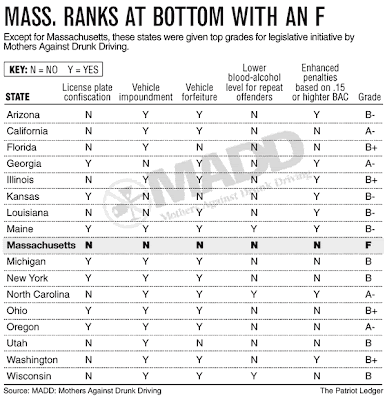
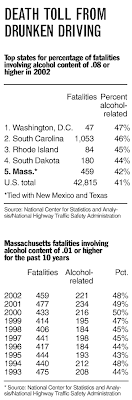
Here are a few quotes from this series:
* Massachusetts is the worst in the nation at finding out who’s been drinking, driving and causing deadly crashes. - http://www.southofboston.net/specialreports/drunkendriving/111806a.shtml
* Surviving drivers were tested in only five of 296 fatal crashes in Massachusetts last year. That's 1.7 percent, lowest in the country. According to the National Highway Traffic Safety Administration, the national average was 31 percent.
The federal agency has pushed for years to test all drivers involved in deadly accidents. But nine states, including Massachusetts, still do not require or even recommend blood-alcohol testing of surviving drivers in fatal crashes.
Massachusetts tests nine out of 10 victims of fatal crashes as part of routine autopsies. -
http://www.southofboston.net/specialreports/drunkendriving/111806a.shtml
* Flunking the test: Mass. policy is nation's most lax
Massachusetts has no law requiring alcohol testing, but five other states do.Drivers involved in fatal accidents in New Hampshire have no right to refuse blood-alcohol tests if they’re suspected of causing the crash.
“The officer can actually, if need be, restrain the person physically while the blood is being withdrawn,” said Earl Sweeney, assistant commissioner of public safety in New Hampshire.
Maine has the same policy, but it applies to all fatal accidents regardless of who’s at fault.
“We test anybody in a serious accident where death occurs or is likely to occur,” said Kennebec County District Attorney Evert Fowle, head of the Maine Prosecutors Association. “It’s certainly called for by the law, and we do it.”
Maine tests 77 percent of drivers involved in fatal crashes, second only to South Carolina’s 94 percent. New Hampshire tested 32 percent, slightly above the national average.
But in Massachusetts, police can ask drivers to take a test only after they’ve been arrested for drunk driving. Here, the number tested is less than 2 percent. No other state tests so few drivers.
- http://www.southofboston.net/specialreports/drunkendriving/111806a.shtml
* Good lawyers, soft judges: Drunks still drive - No jail time for 85% of those convicted
...and more than two dozen other South Shore drivers who are currently facing their third, fourth, fifth, even eighth drunken driving offenses.
Why are they still on the road?
Prosecutors, police and anti-drunken driving advocates say the answer lies in a 10,000-word state law that treats drunken driving as a petty crime, gives judges wide latitude in sentencing and allows even chronic drunken drivers to claim hardship to get their licenses back. An overloaded court system, cutbacks in alcohol treatment and a Legislature reluctant to adopt tougher sentencing mandates also contribute to the problem, they say.
All of this has combined to give Massachusetts one of the nation's worst track records for dealing with drunken drivers, both first-time and habitual offenders.
Consider the statistics:
- Federal highway safety reports show that only four states have a greater percentage of alcohol-related fatalities than Massachusetts.
- While the percentage of fatalities caused by drunken driving has declined nationally during the past 20 years, Massachusetts' has declined at a lower rate than the national average, and only marginally since 1993.
- Massachusetts received a D-minus last year from Mothers Against Drunk Driving. The only lower grade was Montana's F.
- Faced with the loss of federal highway money, Massachusetts this year became the last state in the nation to adopt the so-called "per se" law, which defines a blood-alcohol level of .08 as irrefutable proof in court that a person is legally drunk.
- http://www.southofboston.net/specialreports/drunkendriving/1a.shtml
* Federal studies estimate that drunken driving costs the United States $114 billion a year in medical expenses, lost wages and decreased quality of life. Massachusetts' share of that bill is $1.8 billion.
The statistics obscure a compound tragedy experienced by many victims and families: often the auto insurance carried by the drunken driver, or by the victims, is totally inadequate to cover the costs.
Repeat offenders who have lost their license may have no insurance at all, forcing victims to rely only on their own. In any case, victims sometimes face years of litigation to recoup some of their costs.
- http://www.southofboston.net/specialreports/drunkendriving/2a.shtml
Graphics from "Driving to Endanger" - Patriot Ledger Series
Wednesday, March 21, 2007
Melanie's Law - Massachusetts OUI Law Changes
The following is from a website that is set up by a law firm that defends DWI/DUI/OUI Drivers, http://www.madrunkdrivingdefense.com/melanieslaw.htm - Sue
Melanie's Law - Massachusetts OUI Law Changes
Massachusetts Passed "Melanie's Law" on October 28, 2005
Some of the new changes to Massachusetts Drunk Driving / OUI laws are as follows...
For First Offenders (1st Offense) Massachusetts DUI/OUI:
If You Refused the Breath Test:
- No 15 day temporary license
- May impound your car for 12 hours
- License Suspension consecutive with any OUI conviction penalty
- Under 21 Breath Test refusal 1st OUI offense - 3 year license suspension
- The Breath Test refusal penalty is a 180 day license suspension (no change with Melanie's Law, other than the consecutive license suspension)
If you are Found Guilty:
- Under 21 with BAC of over .20 must attend a 14-day second offender in-home program
For Second Offenders (2nd Offense) Massachusetts DUI/OUI:
If You Refused the Breath Test:
- 3 Year License Suspension, consecutive with any OUI conviction penalty
- Under 21 Breath Test refusal 2nd OUI offense - 5 year license suspension
If you are Found Guilty:
- Not eligible for work/school hardship license for 1 year (+3 additional years of if you refused the breath test)
- As of 1/1/06, Ignition Interlock device installed in your car at your own expense for 2 years as a condition of license reinstatement.
For Third Offense (3rd Offense) OUI Massachusetts OUI / Drunk Driving
If You Refused the Breath Test:
- Under 21 Breath Test refusal 3rd OUI offense - Lifetime license suspension
If you are Found Guilty:
- They can seize, keep, and sell your vehicle for a third or subsequent OUI offense..
- Not eligible for work/school hardship license for 2 year (+5 additional years of if you refused the breath test)
- The Registry may cancel your registration while your license is suspended for a third or subsequent OUI offense.
New OUI Related Laws
- If you live outside of Massachusetts, you may take an eligible treatment program in your state as part of your penalty.
- Committing OUI-related offenses while having a license suspended or revoked for OUI-related reasons (OUI, vehicular homicide, OUI with serious injury, OUI or homicide in a boat, or vehicular manslaughter) Penalty for conviction - mandatory minimum sentence of 1 year, to be served consecutively to any other sentence.
- Your vehicle may be forfeited for a 4th (fourth) offense OUI or subsequent offense.
- Child Endangerment by Operating Under the Influence - If you are convicted of an OUI while a child under 14 is in the car, their is an additional penalty of a license loss of 1 year (consecutive with any other license loss period). Mandatory 6 months in jail for a 2nd offense, and a 3 year license loss (consecutive)
Other Related New Laws
Tuesday, March 20, 2007
Massachusetts Homicide and Vehicular Homicide Laws
Sorry for the delay in posting...I tripped a couple of days ago and broke a couple of bones in my right hand (sigh) so typing is going a bit slow. The knuckles where my little finger and my ring finger attach to my hand are a bit "mashed". I guess my brother and I have the same Klutz gene...he broke fingers and knuckles on the same hand about 4 weeks ago.
I've received some more response to my letters and phone calls regarding strengthening the repeat offender DWI/DUI/OUI laws (they all have the same meaning according to Mass. law). In addition to hearing back from MA Rep. Jeffrey Perry and MA State Senator Mark Montigney I have also received a letter from Vice President Cheney and the MA State Attorney General. Today I have a message on my answering machine to return a call from Sen. John Kerry's office.
A Brief Overview of Massachusetts Homicide Law
Massachusetts law defines a homicide as the willful (non-negligent) killing of one human being by another. There are two categories of criminal homicide under Massachusetts law-murder and manslaughter. There are also different classifications of murder and manslaughter. Which homicide crime has been committed (and the punishment that can or must be imposed) generally depends on the manner in which the crime was committed and the intent on the part of the perpetrator.
Classifications of Murder / Punishment
First Degree Murder / Life, without possibility of parole
Second Degree Murder / Life, parole elegibility after 15 years
Classifications of Manslaughter / Punishment
Voluntary Manslaughter / State prison up to 20 years; plus fines
Involuntary Manslaughter / State prison up to 20 years; plus fines
Vehicular Homicide / State prison up to 20 years; plus fines
A Brief Overview of Massachusetts Vehicular Homicide Law
(Melanie's Law increased the mandatory minimum, more info in next post-Sue)
Vehicular Homicide While Operating Under the Influence of Alcohol or Other Drugs and While Operating To Endanger = Mandatory minimum 2 ½ years and up to 15 years in state prison or mandatory minimum 1 year and up to 2 ½ years in jail; plus fines*
Vehicular Homicide While Operating Under the Influence of Alcohol or Other Drugs or While Operating To Endanger = Mandatory minimum 30 days and up to 2 1/2 years in jail; plus fines*
*Also loss of license
Massachusetts Vehicular Homicide Statistics (1998):
1998 alcohol-related statistics for Massachusetts
All traffic fatalities/Alcohol-related fatalities/% Alcohol-related
406 / 192 / 47.4*%
Statistics from National Highway Traffic Safety Administration (NHTSA)
National Vehicular Homicide Trends - According to the National Highway Transportation Safety Administration (NHTSA):
* More than 35% of all 16-to-20 year-old deaths result from motor vehicle crashes.
* 37% of these motor vehicle fatalaties were alcohol-related crashes.
* The troubling news: During a typical weekend, an average of one teenager dies each hour in a car crash. Car crashes are the #1 cause of death among teens.
* Promising news: Since 1989, less than half of youth motor vehicle fatalities have been alcohol-related.
Sue
I've received some more response to my letters and phone calls regarding strengthening the repeat offender DWI/DUI/OUI laws (they all have the same meaning according to Mass. law). In addition to hearing back from MA Rep. Jeffrey Perry and MA State Senator Mark Montigney I have also received a letter from Vice President Cheney and the MA State Attorney General. Today I have a message on my answering machine to return a call from Sen. John Kerry's office.
The following information is from the Norfolk County Massachusetts District Attorney's website
A Brief Overview of Massachusetts Homicide Law
Massachusetts law defines a homicide as the willful (non-negligent) killing of one human being by another. There are two categories of criminal homicide under Massachusetts law-murder and manslaughter. There are also different classifications of murder and manslaughter. Which homicide crime has been committed (and the punishment that can or must be imposed) generally depends on the manner in which the crime was committed and the intent on the part of the perpetrator.
Classifications of Murder / Punishment
First Degree Murder / Life, without possibility of parole
Second Degree Murder / Life, parole elegibility after 15 years
Classifications of Manslaughter / Punishment
Voluntary Manslaughter / State prison up to 20 years; plus fines
Involuntary Manslaughter / State prison up to 20 years; plus fines
Vehicular Homicide / State prison up to 20 years; plus fines
A Brief Overview of Massachusetts Vehicular Homicide Law
(Melanie's Law increased the mandatory minimum, more info in next post-Sue)
Vehicular Homicide While Operating Under the Influence of Alcohol or Other Drugs and While Operating To Endanger = Mandatory minimum 2 ½ years and up to 15 years in state prison or mandatory minimum 1 year and up to 2 ½ years in jail; plus fines*
Vehicular Homicide While Operating Under the Influence of Alcohol or Other Drugs or While Operating To Endanger = Mandatory minimum 30 days and up to 2 1/2 years in jail; plus fines*
*Also loss of license
Massachusetts Vehicular Homicide Statistics (1998):
1998 alcohol-related statistics for Massachusetts
All traffic fatalities/Alcohol-related fatalities/% Alcohol-related
406 / 192 / 47.4*%
Statistics from National Highway Traffic Safety Administration (NHTSA)
National Vehicular Homicide Trends - According to the National Highway Transportation Safety Administration (NHTSA):
* More than 35% of all 16-to-20 year-old deaths result from motor vehicle crashes.
* 37% of these motor vehicle fatalaties were alcohol-related crashes.
* The troubling news: During a typical weekend, an average of one teenager dies each hour in a car crash. Car crashes are the #1 cause of death among teens.
* Promising news: Since 1989, less than half of youth motor vehicle fatalities have been alcohol-related.
Sue
Friday, March 16, 2007
www.JusticeForDiane.com
To make it easier to find this site, and since I have found that Google is now listing us in the blog search and not their regular internet search, I have set up www.JusticeForDiane.com which will bring you right to this site. If you have already bookmarked this site or saved it to your favorites, do not worry, you will still be brought right to the home page as usual.
Sue
Sue
Wednesday, March 14, 2007
Christopher G. Parker has a spotty driving record going back to 1982
The following information was included in the Cape Cod Times March 14, 2007 article titled "Crash spurs fresh call for tougher state laws" written by reporter George Brennan. The full article can be found in the links section on the left side of this site. I am shocked that Christopher G. Parker hasn't been incarcerated before this time.
As you read through this list of offenses and convictions I hope you share my shock that this man was even allowed out of prison..and he is still out on the streets! Who will his reckless actions affect next? I have learned Mr. Parker has a young son. Mr Parker's irresponsible actions not only took my mother's life and caused injuries to the driver of the NStar truck but his son will grow up without a father if we are successful in placing Mr Parker behind bars.
Please think of the total consequences if you are tempted to drink or use drugs (illegal or not) and choose to drive while you are impaired in any way. This record goes to show once again the total lack of respect that Christopher G. Parker has for anything or anyone except himself. I guess he believes that the laws of the State of Massachusetts apply to everyone except himself. No wonder he didn't seem too upset while he was in court yesterday - he is a pro at this!
May 21, 1982: Charged with operating under the influence of alcohol, West Bridgewater. Convicted Dec. 17, 1982.
Sept. 28, 1982: Charged with operating under the influence of alcohol, Hingham. Convicted Dec. 17, 1982. Ordered to attend alcohol treatment program.
April 6, 1998: Charged with operating under the influence of alcohol, Sandwich. Convicted June 29, 1998. Ordered to attend 45 day treatment program.
March 21, 1999: Charged with operating under the influence of alcohol, Sandwich. Convicted
April 20, 1999. License revoked for two years and ordered to attend alcohol treatment program.
June 14, 2002: Charged with operating under the influence of drugs, Sandwich. Dismissed June 12, 2003.
Over the past 25 years, he has also been cited for speeding five times, causing an accident once and driving without an inspection sticker once.
Source: Registry of Motor Vehicles
As you read through this list of offenses and convictions I hope you share my shock that this man was even allowed out of prison..and he is still out on the streets! Who will his reckless actions affect next? I have learned Mr. Parker has a young son. Mr Parker's irresponsible actions not only took my mother's life and caused injuries to the driver of the NStar truck but his son will grow up without a father if we are successful in placing Mr Parker behind bars.
Please think of the total consequences if you are tempted to drink or use drugs (illegal or not) and choose to drive while you are impaired in any way. This record goes to show once again the total lack of respect that Christopher G. Parker has for anything or anyone except himself. I guess he believes that the laws of the State of Massachusetts apply to everyone except himself. No wonder he didn't seem too upset while he was in court yesterday - he is a pro at this!
May 21, 1982: Charged with operating under the influence of alcohol, West Bridgewater. Convicted Dec. 17, 1982.
Sept. 28, 1982: Charged with operating under the influence of alcohol, Hingham. Convicted Dec. 17, 1982. Ordered to attend alcohol treatment program.
April 6, 1998: Charged with operating under the influence of alcohol, Sandwich. Convicted June 29, 1998. Ordered to attend 45 day treatment program.
March 21, 1999: Charged with operating under the influence of alcohol, Sandwich. Convicted
April 20, 1999. License revoked for two years and ordered to attend alcohol treatment program.
June 14, 2002: Charged with operating under the influence of drugs, Sandwich. Dismissed June 12, 2003.
Over the past 25 years, he has also been cited for speeding five times, causing an accident once and driving without an inspection sticker once.
Source: Registry of Motor Vehicles
Subscribe to:
Posts (Atom)